
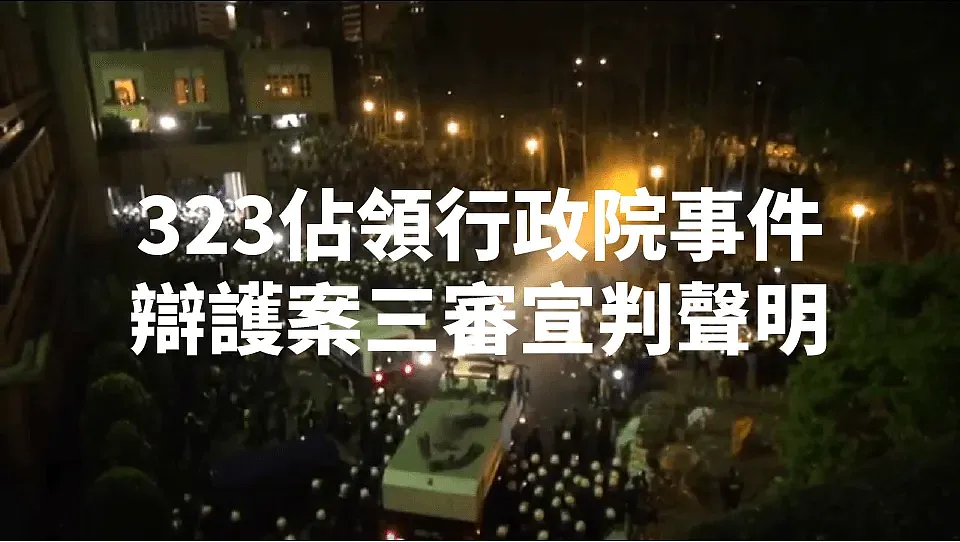
Statement on the Third-Instance Judgment in the March 23 Executive Yuan Occupation Defense Case
Last edited: 2026-08-29
Today, the Criminal Division of the Supreme Court delivered judgment in the third-instance proceedings arising from the March 23 Executive Yuan occupation. The Supreme Court vacated the lower-court judgment and remanded the case to the Taiwan High Court.
The defense team welcomes the Supreme Court's willingness to confront the complexity of the legal issues, grant the defendants' request for oral argument, and hear four experts address the instigation offense, civil disobedience, and the right of resistance.
At the same time, the pro bono defense team regrets that the Supreme Court declined to suspend the trial and petition the Grand Justices for a constitutional interpretation of Article 153 of the Criminal Code, the offense of instigating others to commit offenses. More than 30 years after Taiwan's democratization, this case offered an important opportunity to reexamine an authoritarian-era remnant in the Criminal Code. The defense relied on multiple Judicial Yuan interpretations to argue that Article 153 violates the principles of legal clarity, proportionality, and equality; comparative-law analysis presented by experts likewise found that what the offense fundamentally protects is the absoluteness of the exercise of state power. Even the prosecutor from the Supreme Prosecutors Office urged the panel at oral argument to suspend the trial and petition for a constitutional interpretation. The Supreme Court instead adopted a constitutionally conforming interpretation without referring the question to the Grand Justices. Although the defendants may continue asserting their rights after remand, the opportunity for a fundamental review of the offense's constitutional legitimacy has been missed, which the defense team deeply regrets.
Nearly seven years have passed since the March 23 Executive Yuan occupation. Through years of litigation, the defendants and defense team have sought to create greater space for democracy and the rule of law in Taiwan. Because the case remains pending, we hope the Taiwan High Court will confront its significance in Taiwan's constitutional and legal history and interpret the instigation offense, civil disobedience, and the right of resistance consistently with constitutional principles.
The defense team will continue to stand with the defendants through the remainder of this long process. We hope Taiwan will continue moving toward a stronger and deeper constitutional democracy governed by the rule of law.
Disposition by Defendant
| Indicted Offense | Defendant | First Instance | Second Instance | Third Instance |
| Damaging Property Under the Custody of a Public Official | Li Kuan-ling | Four months' imprisonment, commutable to a fine | Appeal dismissed | All vacated and remanded |
| Hsu Shun-chih | Four months' imprisonment, commutable to a fine | Two months' imprisonment for the instigation offense, commutable to a fine; to be executed together with the sentence for damaging property under the custody of a public official, for a total of five months | ||
| Instigating Others to Commit Offenses | Wei Yang | Not guilty | Four months' imprisonment, commutable to a fine | |
| Chen Ting-hao | Not guilty | Four months' imprisonment, commutable to a fine | ||
| Chiang Ping-lun | Not guilty | Three months' imprisonment, commutable to a fine | ||
| Liu Ching-wen | Not guilty | Two months' imprisonment, commutable to a fine | ||
| Lin Chien-hsing | Not guilty | Three months' imprisonment, commutable to a fine | ||
| Ko Ting-yu | Not guilty | Two months' imprisonment, commutable to a fine |
Attachment
Press Contact
Attorney Lee Ming-ju, Staff Attorney, Judicial Reform Foundation
This article is an AI-generated translation of the original Chinese text. In the event of any discrepancy, the Chinese version shall prevail.
