
[Legal Life]Ch17 My Exploitative Boss Is Firing Me!
Last edited: 2026-08-30
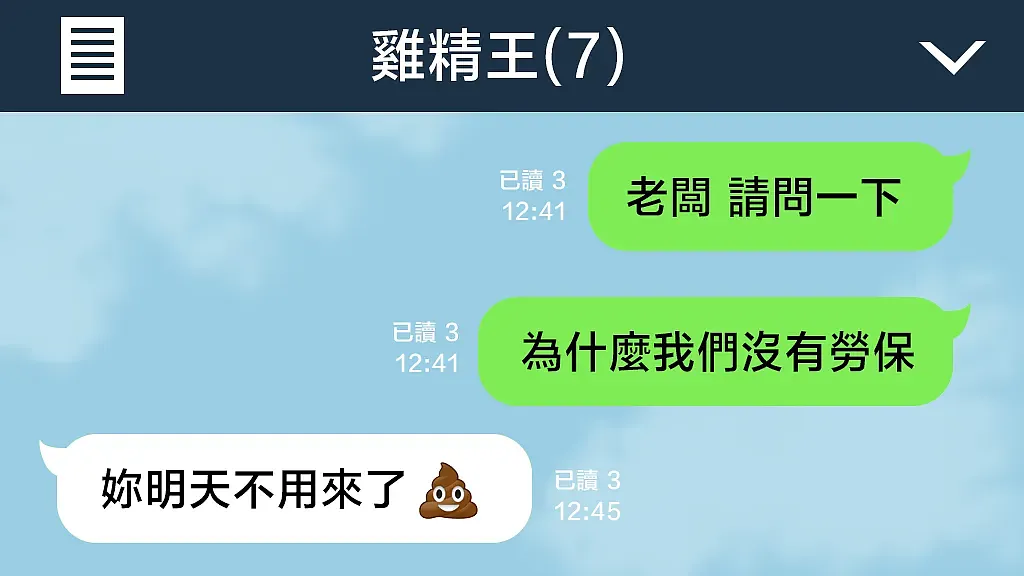
Not long after Yu-Ling experienced sexual harassment, the boss who had previously managed to turn chicken essence into clam essence heard about her courageous complaint and admired her for it. He recruited Yu-Ling to make slow-dripped chicken essence eight hours a day. She quickly got the hang of the work, but one day she was scalded by hot chicken essence and expected to be unable to work for a while. Knowing that occupational-accident benefits were available under labor insurance, she applied-only to learn from the competent authority that her employer had never enrolled her in labor insurance at all. Furious and anxious, Yu-Ling confronted her boss. After hearing her out, he simply said, "You don't need to come in tomorrow," and handed her a box of chicken essence (the right kind this time) as a farewell gift.
The next day, Yu-Ling still showed up at the chicken-essence shop ready to work, only to find that her boss truly would not acknowledge her or let her in. For several days she kept sending him LINE and text messages saying, "I'm ready! I want to make chicken essence!" but he left her on read. Yu-Ling's life had hit a wall...
Key Issues
- Compensation for damages resulting from failure to enroll in labor insurance
- Employers' and workers' rights to terminate employment contracts
- Remedies that help workers enforce their rights
Compensation for damages resulting from failure to enroll in labor insurance
Article 72, Paragraph 1 of the Labor Insurance Act provides that if an employer fails to enroll a worker in labor insurance, the employer may not only be fined by the competent authority; the worker may also claim compensation from the employer for losses caused by being unable to receive labor-insurance benefits. The provision also applies in situations such as an employer underreporting the insured salary and thereby reducing the worker's old-age benefits (Paragraph 3 of the same Article).
In Yu-Ling's case, occupational-accident insurance provides benefits for injury and sickness, disability, death, and other risks. Had the chicken-essence shop owner enrolled her, Yu-Ling would have been eligible for injury and sickness benefits. Because the boss failed to enroll her, she may claim from him the amount of benefits calculated under the Labor Insurance Act-down to the last dollar.
Rights of employers and workers to terminate contracts
-
Employer's right to terminate the contract
Unlike the familiar TV-drama scene in which a boss says "YOU'RE FIRED!" and the employee sadly leaves carrying a cardboard box, Taiwan's Labor Standards Act places relatively strict limits on an employer's right to terminate an employment contract. An employer may terminate only when a statutory ground under Article 11, Article 12, Paragraph 1, or the proviso to Article 13 is satisfied.
Most court decisions further hold that, even when a statutory ground exists, termination must satisfy the principle that dismissal is a last resort. In practice, an employer seeking to lay off or dismiss a worker therefore must clear a two-step test.
If an employer lays off a worker under Article 11 or the proviso to Article 13 of the Labor Standards Act, the employer must pay severance, provide job-search leave, and give the required advance notice (or pay wages in lieu of notice), because the termination is not based on employee fault. By contrast, if the employer dismisses a worker for fault under Article 12, Paragraph 1, severance, job-search leave, and advance notice are not required. In either case, however, the statutory requirements must actually be met.
-
Worker's right to terminate the contract
Compared with the relatively strict limits on an employer's right to terminate, a worker may generally resign at will, subject to the advance-notice requirements of Article 15 of the Labor Standards Act. If one of the serious circumstances listed in Article 14 occurs-for example, violence or gross insult by the employer, or work that endangers the worker's health-the worker may terminate without advance notice.
A worker who terminates without notice under Article 14 may also claim severance because the cause of termination lies with the employer. One timing rule is especially important: if the worker relies on Article 14, Paragraph 1, Subparagraph 1 (fraudulent representations by the employer when the labor contract was made) or Subparagraph 6 (violation of the labor contract or labor laws that threatens the worker's rights), the worker must terminate within 30 days after learning of the relevant circumstance. If that period expires, termination on that ground is ineffective and the employment relationship remains in place.
-
What Can Yu-Ling Claim?
If Yu-Ling feels that the working conditions at the chicken essence shop are good,
and the chicken essence is also delicious,and she wants to continue working with her boss, she can claim that:- The boss told Yu-Ling not to work even though none of the statutory grounds in Article 11, Article 12, Paragraph 1, or the proviso to Article 13 of the Labor Standards Act was satisfied. The purported termination is therefore unlawful, the employment relationship remains in existence, and Yu-Ling may return to work;
- Under Article 487 of the Civil Code, because the boss refused to accept Yu-Ling's services, he must continue paying her wages for the period in which she did not work;
- The boss must also compensate Yu-Ling for the injury and sickness benefits she would have received under Article 72, Paragraph 1 of the Labor Insurance Act.
If Yu-Ling believes that an employer who is unwilling even to enroll her in labor insurance is not worth working with, she can claim that:
- In addition to the aforementioned three points, Yu-Ling may additionally claim:
- Under Article 14, Paragraph 1, Subparagraph 6 of the Labor Standards Act, Yu-Ling may, within 30 days after learning that the boss unlawfully failed to enroll her in labor insurance, terminate the contract prospectively and claim severance pay.
When rights are infringed, is litigation the only option?
Compared with litigation, which usually requires more time and money, the quickest and most convenient route for a worker whose rights have been infringed is often to apply for labor-management dispute mediation with the special-municipality or county (city) government where the worker provides services.
Under Article 10 of the Act for Settlement of Labor-Management Disputes, a worker may apply for mediation by completing a mediation application stating the parties' names, genders, ages, occupations, and residence or domicile, the matters to be mediated, and the requested mediation method. Labor-affairs departments of special-municipality and county (city) governments provide standard forms, and staff are available to answer questions.
Mediation is available both for disputes over rights and obligations arising from statutes, collective agreements, or labor contracts and for disputes over maintaining or changing working conditions. Common mediation requests therefore include challenges to unlawful termination and requests for reinstatement, as well as claims for overtime pay, severance, pension shortfalls, and losses caused by labor-insurance violations.
Yu-Ling may therefore apply for labor-management dispute mediation with the labor-affairs department of the special-municipality or county (city) government where the chicken-essence shop is located and, depending on her needs, assert the rights described above so that she can return to a normal life as soon as possible.
How the story should continue
After consulting a lawyer, Yu-Ling successfully recovered the occupational-accident benefits owed because of her employer's failure to enroll her, as well as wages for the period during which the employer refused to accept her services. Because the boss's termination was unlawful, the employment relationship still exists. Yu-Ling may return to the chicken-essence shop and keep working, or she may terminate the contract under Article 14, Paragraph 1, Subparagraph 6 of the Labor Standards Act on the ground that the boss violated labor laws by failing to enroll her in labor insurance and unlawfully dismissing her, and then claim severance pay as she starts a new chapter.
Relevant Legal Provisions
Article 11 of the Labor Standards Act: "An employer shall not terminate a labor contract without giving advance notice unless one of the following situations occurs:
1. When the enterprise is closing down or transferred.
2. When the enterprise suffers losses or business contraction.
3. When suspension of work due to force majeure necessitates a shutdown for more than one month.
4. When the nature of the business changes, necessitating a reduction of workers, and there are no suitable positions available for reassignment.
5. When a worker is manifestly unable to perform the duties required of the position."
Article 12 of the Labor Standards Act: "An employer may terminate a contract without advance notice if a worker falls under any of the following circumstances:
1. Making false statements at the time of concluding the labor contract, thereby misleading the employer and creating a risk of sustaining damage.
2. Committing acts of violence or gross insults against the employer, the employer's family members, the employer's agent, or other co-workers.
3. Being sentenced to a final and conclusive imprisonment penalty without the grant of a suspended sentence or permission to commute the sentence to a fine.
4. Violating the labor contract or work rules in a gross manner.
5. Intentionally damaging machinery, tools, raw materials, products, or other property belonging to the employer, or intentionally leaking technical or business secrets of the employer, resulting in damage to the employer.
6. Being absent from work without justifiable reason for three consecutive days, or for six days in a month.
An employer terminating a contract pursuant to Subparagraphs 1, 2, and 4 through 6 of the preceding paragraph shall do so within 30 days from the date of knowing the circumstances."
Article 14 of the Labor Standards Act: "A worker may terminate a contract without advance notice under any of the following circumstances:
1. Where the employer makes false statements at the time of concluding the labor contract, thereby misleading the worker and creating a risk of sustaining damage.
2. Where the employer, the employer's family members, or the employer's agent commits acts of violence or gross insults against the worker.
3. Where the work specified in the contract poses a hazard to the worker's health, and no effect is produced after notifying the employer to make improvements.
4. Where the employer, the employer's agent, or other workers contract a malignant and contagious disease with a risk of transmission.
5. Where the employer fails to pay remuneration for work in accordance with the labor contract, or fails to provide sufficient work for piece-rate workers.
6. Where the employer violates the labor contract or labor laws and regulations, creating a risk of infringing upon the worker's rights.
A worker terminating a contract pursuant to Subparagraph 1 or Subparagraph 6 of the preceding paragraph shall do so within 30 days from the date of knowing the circumstances.
Where the circumstances in Subparagraph 2 or Subparagraph 4 of Paragraph 1 apply, and the employer has already dismissed the agent or sent the person with the malignant and contagious disease for medical treatment or dismissed them, the worker may not terminate the contract.
The provisions of Article 17 shall apply mutatis mutandis to the termination of a contract under this Article."
Article 16 of the Labor Standards Act: "Where an employer terminates a labor contract pursuant to Article 11 or the proviso of Article 13, the advance notice period shall be in accordance with the following provisions:
1. Where the worker has continued to work for at least three months but less than one year, notice shall be given 10 days in advance.
2. Where the worker has continued to work for at least one year but less than three years, notice shall be given 20 days in advance.
3. Where the worker has continued to work for at least three years, notice shall be given 30 days in advance.
After receiving the advance notice mentioned in the preceding paragraph, a worker may request time off to leave the workplace to seek alternative employment. Such leave hours shall not exceed two days of working time per week, and wages during the leave period shall be paid as usual.
Where an employer terminates a contract without giving advance notice during the periods prescribed in Paragraph 1, the employer shall pay wages for the advance notice period."
Paragraph 1, Article 72 of the Labor Insurance Act: "Where an insured unit violates the provisions of this Act by failing to process enrollment procedures for its affiliated workers, a fine of four times the amount of insurance premiums payable from the date of employment until the day prior to joining insurance or the worker's resignation date shall be imposed. Any losses suffered by the worker thereby shall also be compensated by the insured unit in accordance with the benefit standards prescribed by this Act."
This article is an AI-generated translation of the original Chinese text. In the event of any discrepancy, the Chinese version shall prevail.
