
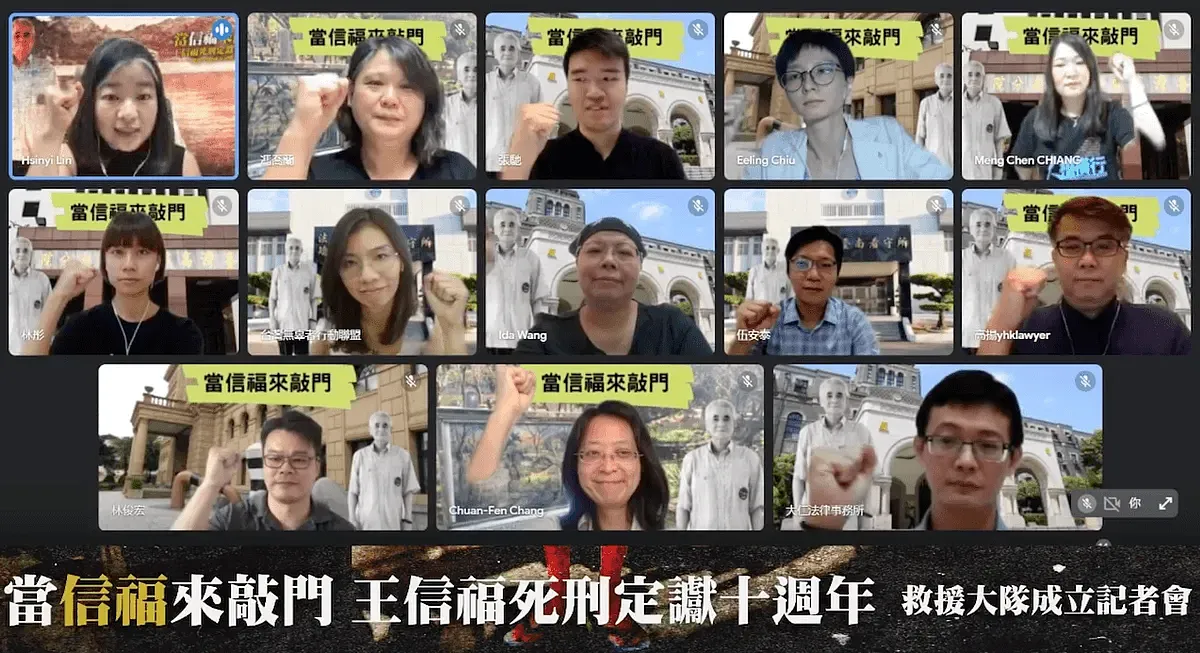
Ten Years Since Wang Hsin-Fu's Death Sentence Became Final-Full Speeches from the Rescue Team Launch Press Conference
Last edited: 2026-08-30
Chairperson Chang Chuan-Fen (Taiwan Alliance to End the Death Penalty)
It has been a long ten years. On this day in 2011, Wang Hsin-Fu's death sentence became final, placing his life on a knife-edge. If the Minister of Justice signs an execution order, the state will shoot him through the heart-and regard the process as lawful.
The central problem in the Wang Hsin-Fu case is the weakness of the evidence. Chen Jung-Chieh, the actual shooter, killed two police officers. The court found that Wang handed him the gun and ordered him to fire, yet forensic testing found none of Wang's fingerprints on the weapon. The death sentence rested primarily on Chen's statement. That statement raises four problems: first, Chen repeatedly changed his account, calling its consistency into question; second, his account conflicted with eyewitness testimony, calling its credibility into question; third, he was never confronted and cross-examined in court, calling its reliability into question; and fourth, the original interrogation recordings disappeared, making voluntariness difficult to assess.
There is no scientific evidence tying Wang Hsin-Fu to the crime; the case depends on an accusation by the actual shooter implicating him. That pattern resembles the Su Chien-Ho, Hsu Tzu-Chiang, and Hsieh Chih-Hung cases. Wang had no apparent motive, and witnesses alleged that police used torture and improper interrogation to obtain testimony against him, as in the Cheng Hsing-Tse and Chiou Ho-shun cases. Since the movement to remedy wrongful convictions gained momentum with the Su Chien-Ho case in 1995, many wrongful death-penalty cases have followed a recurring formula: scientific evidence is discounted while weak evidence such as a co-defendant's confession is used to convict. The Wang Hsin-Fu case is a product of that same formula.
Over the past decade, we have pursued retrial, extraordinary appeal, and constitutional interpretation; written articles; held forums and academic conferences; and published a comic booklet. We turned Wang Hsin-Fu's case into a mock-trial program that toured high schools and universities-the first time in Taiwan that a mock trial was used to advocate for a wrongful-conviction case. We also made Judging Wang Hsin-Fu, Taiwan's first docudrama used to support such a case. Now Wang's case is once again knocking on the door of a government institution. We hope the Supreme Prosecutors Office will uphold the principle of neither wrongfully punishing the innocent nor allowing the guilty to escape, and open the door.
Chairperson Lin Chun-Hung (Taiwan Criminal Defense Lawyers Association; Wang Hsin-Fu Rescue Attorney)
The court sentenced Wang Hsin-Fu to death on the basis of a story that does not make logical sense.
According to the court's account, Wang Hsin-Fu and his companions arrived at Hung Ching-I's establishment at about 3:00 a.m. Li Kuang-Lin, for reasons the judgment did not explain, left to obtain a gun and handed it to Wang when he returned. Later, while Wang was criticizing the establishment, the two police-officer victims spoke up for the proprietor. Wang supposedly became angry and instructed Chen Jung-Chieh to shoot them, causing their deaths.
But the court's story does not add up.
First, Li Kuang-Lin supposedly went to obtain the gun before Wang Hsin-Fu had any dispute with the police officers. Wang had gone out that night to sing and drink, and nothing had happened. Why would Li leave to get a gun for Wang before any conflict existed? That part of the court's narrative makes no sense.
Second, the court found that Wang ordered Chen Jung-Chieh to shoot. But Chen was Li Kuang-Lin's subordinate, not Wang's. Even assuming the dispute and the retrieval of the gun occurred as the court found, the story requires Wang to order someone else's subordinate to commit the shooting-and for Chen simply to obey. Given that Wang had no actual authority over Chen, this too is difficult to explain.
Third, the judgment does not explain why, after the shooting, Li Kuang-Lin-not Wang Hsin-Fu-arranged Chen Jung-Chieh's life on the run, while Chen had no contact with Wang at all. If the court's account were correct, one would expect Wang to arrange Chen's escape and Chen to seek Wang's help.
Beyond the logical problems, the court never gave Wang Hsin-Fu an opportunity to confront and cross-examine the two key figures, Li Kuang-Lin and Chen Jung-Chieh. It relied directly on untested testimony to convict him, creating an obvious procedural unfairness.
The death judgment thus contains serious problems both in procedural safeguards and in fact-finding. We now bring those procedural and substantive defects to the Supreme Prosecutors Office and hope the justice system will open the door for Wang Hsin-Fu-so that he can go home and finally have a chance at a peaceful life.
Attorney Kao Yang-Hui (Vice Chairperson, Taiwan Alliance to End the Death Penalty; Wang Hsin-Fu Rescue Attorney)
After Wang Hsin-Fu's conviction became final in 2011, local Tainan attorneys promptly assisted with four retrial applications between 2011 and 2013. In 2013, Taipei attorney Wang I-Chin assisted with an application for extraordinary appeal, while I assisted with a petition to the Grand Justices for constitutional interpretation. All of the factual, legal, and constitutional defects raised through those extraordinary remedies were nevertheless rejected.
The rescue team has consistently maintained that the state's decision to execute Chen Jung-Chieh before Wang Hsin-Fu was apprehended deprived Wang of any opportunity to confront and cross-examine this crucial co-defendant and witness. Under the principle of attribution, the disadvantage caused by the resulting uncertainty in the facts should not be borne by Wang. To do so would violate his rights to confrontation and cross-examination and to a fair trial under Judicial Yuan Interpretation No. 582 and Article 14 of the ICCPR.
Accordingly, Chen Jung-Chieh's police statement before his execution-that Wang pointed at the two police officers and said, "Take care of those two"-should be excluded from evidence. Once that principal incriminating statement is removed, the case plainly lacks legally sufficient evidence that Wang and Chen conspired to shoot the officers. Extraordinary remedies should be used to secure an acquittal and clear Wang Hsin-Fu's name.
Attorney Wu An-Tai (Criminal Human Rights Committee, Tainan Bar Association; Wang Hsin-Fu Rescue Attorney)
The Wang Hsin-Fu case is highly controversial. The court found that Wang supplied the murder weapon, yet forensic testing found none of his fingerprints on it. By the time of trial, the most important witness-the shooter-had already been executed, so Wang had no opportunity to confront a witness whose credibility was disputed. The death sentence was imposed without physical evidence and rested principally on the shooter's untested confession. At the final fact-finding retrial, the judgment also treated Wang's flight after the incident as evidence of a consciousness of guilt, revealing prejudgment in the court's reasoning.
The proceedings infringed Wang Hsin-Fu's right to defend himself, and the evidence did not reach the standard required for conviction, much less a death sentence. Because Wang remains under a final death sentence and may be executed, the rescue effort is urgent. We hope the courts and prosecutors will give him an opportunity for retrial so the prosecution, defense, and judiciary can re-examine the case and allow him to return home as soon as possible.
Attorney Wang I-Chin (Executive Committee Member, Taiwan Alliance to End the Death Penalty; Wang Hsin-Fu Rescue Attorney)
Today marks the tenth anniversary of the Wang Hsin-Fu judgment becoming final on July 27, 2011, and nearly 31 years since the incident on August 10, 1990.
During that time, Taiwan substantially revised the Code of Criminal Procedure in 2003 and added numerous due-process protections. Yet in Wang Hsin-Fu's case, statements obtained under the old procedural regime more than thirty years ago continued to be used as evidence of guilt in the era of the new law.
Some may say this situation resulted from Wang Hsin-Fu's years as a fugitive. But when the defense team reviewed the statements, we found that the evidence unfavorable to Wang emerged only after police questioned witnesses again and again, while evidence favorable to him was simply disregarded.
When we finally asked to hear the recordings of the police interrogations, we searched everywhere and could not find them. Even people with the greatest confidence in the judiciary cannot turn a blind eye to defects like these.
The most important witness, co-defendant Chen Jung-Chieh, gave multiple versions of events and at times even shifted responsibility for the shooting onto Wang Hsin-Fu. Chen was executed before Wang was apprehended, so Wang never had an opportunity to challenge him. The relationship between co-defendants is inherently dangerous: a friend can become an adversary, and anyone who has seen such situations portrayed on screen understands the risk.
Because of these defects, successive judgments in the Wang Hsin-Fu case adopted different factual accounts and even different characterizations of the offense. The judges themselves evidently recognized that something was wrong, yet the one constant remained Chen Jung-Chieh's death judgment from thirty years ago. So we have to ask: the law was amended-then what?
Executive Director Huang Chih-Hsien (Taiwan Alliance for the Innocent)
Wang Hsin-Fu is approaching 69. Today is the tenth anniversary of his death sentence becoming final and his 5,404th day without freedom. Fourteen years amount to roughly one-fifth of his life. His life has been placed on pause by a wrongful death-penalty case, and death has remained frighteningly close.
At 18, Wang Hsin-Fu was sent to a compulsory disciplinary program because of unconventional clothing and wandering late at night. From then on, the label of "bad person" stuck to him. When the Taiwan Alliance for the Innocent first met him more than three years ago, it was hard to reconcile the shy man in front of us with the "gang boss" others described. I jokingly called him "Uncle Shy." He would smile bashfully while nervously turning Buddhist prayer beads in his right hand. His embarrassment seemed rooted in a life spent somewhere on society's spectrum between "good" and "bad": because of the way he had lived when young, he felt he could never quite count as a good person. More than once, with an uneasy smile, he told me self-deprecatingly, "I'm a heinous criminal."
Wang Hsin-Fu is not good at arguing his own case. Even though we can talk about almost anything, whenever I ask what he wants to say to the public he responds, "I don't know how to say it," "I don't know what to say," or "You say it for me." It is not that he has nothing to say. After so many years, very few people have wanted to hear him, because people do not want to listen to someone they have already labeled a "bad person."
When I first knew him, whenever he became emotional talking about the injustice of his case, he would immediately change course and say, "Sorry to make a scene," or "Let's stop talking about it." He said he did not want to burden other people with bad experiences and emotions. Only in the past two years has he gradually allowed me to see his feelings without hiding them. I think that comes from slowly believing that I do not see him as the heinous criminal others say he is.
In the more than three years we have known him, Wang Hsin-Fu has felt more like a kind and thoughtful elder. He lost his father when young, and his mother died of illness while he was in prison. His beloved younger sister often wants to visit. Although he misses her, he says, "She's getting older. The drive is tiring and dangerous, so I won't let her come." During the pandemic, he worried that we were at risk outside and reminded us to exercise and drink more water. Every time we meet, he asks us to convey his thanks to the rescue groups and asks after friends he has not seen for some time. "Uncle Shy" has become a warm, if rather talkative, uncle.
From the day we met him, we have never been able to connect Wang Hsin-Fu with the "heinous criminal" he calls himself. Even before he became entangled in this case, he had decided to change his life. He started a tea business, and friends kept urging him to stay out of trouble, dropping by every few days simply to make sure he was at the shop working. "I really wanted to change. I wanted to run a proper business," Wang said. But the state had already produced a young "bad person" and never gave him the chance to become someone else. Soon afterward he was drawn into a wrongful murder case and branded a killer whom everyone believed deserved death.
If he had never been caught up in this case, would Wang Hsin-Fu have become a good person? I do not know. But without this miscarriage of justice, he would at least not have been deprived of the chance to become one. Sixty-nine may not sound especially old outside prison, but imprisonment changes what age means. Wang is Taiwan's oldest death-row prisoner and suffers from eye problems and degenerative joint disease. We hope that in his lifetime we can sit with him in the sunlight and drink tea, rather than speaking through bars and a telephone receiver. That is our promise to one another.
Finally, we hope the state will confront the many defects and doubts in this case and give Wang Hsin-Fu a chance to reopen the proceedings. He may not have another 14 years to wait. The years already lost cannot be restored, but at the very least his name should be cleared so that he can spend his later years in peace.
Director Lin Tung (Taiwan Association for Human Rights)
Since its establishment, the Taiwan Association for Human Rights has worked to advance democracy and the rule of law in Taiwan. Martial law did not merely suppress democracy and freedom; it also prevented the justice system, society's last line of defense, from performing its proper function. Beginning in the 1990s, TAHR, the JRF, the Humanistic Education Foundation, and other groups joined efforts to remedy the cases of Su Chien-Ho, Chuang Lin-Hsun, and Liu Ping-Lang, using civil society to correct errors produced by systemic judicial failure.
Under authoritarian-era laws such as the Statute for the Eradication of Hoodlums, Wang Hsin-Fu had already been classified by the system as a "bad person." He was later drawn into a murder case and, after years as a fugitive, quickly received a final death sentence. Yet the evidentiary structure of the case is full of gaps, and the proceedings failed to give him a full opportunity for confrontation and cross-examination, nearly disregarding the presumption of innocence. Because Taiwan has incorporated the two Covenants into domestic law, TAHR again calls on the government to respect the ICCPR's protection of the right to life, re-examine the unfairness of Wang's trial, and restore his freedom as soon as possible.
Director Chiang Meng-Chen (Covenants Watch)
Covenants Watch has long promoted incorporation of international human-rights treaties into Taiwan law and worked to make universal human rights real by introducing and advocating international standards. The fact that Wang Hsin-Fu could be sentenced to death without a fair trial shows that Taiwan, despite describing itself as a free and democratic society, still falls far short of those standards. In his case, the rights protected by ICCPR Article 6 (right to life), Article 7 (prohibition of torture), and Article 14 (fair trial) were all denied. Taiwan gave the ICCPR domestic legal effect through an implementation act in 2009. Even without reaching questions of customary international law or jus cogens, those ICCPR rights should therefore be fully implemented here. The reality shows that they are not.
How can Taiwan in 2021 still have a person sitting in prison, passively awaiting death, without ever having received a fair trial? We call on the Tsai Ing-Wen administration, while working to build Taiwan's international standing, to examine carefully whether everyone in Taiwan is treated consistently with international human-rights treaties, acknowledge the justice system's past errors, and give Wang Hsin-Fu the freedom he deserves.
Secretary-General Chiu I-Ling (Amnesty International Taiwan)
Amnesty International Taiwan began including Wang Hsin-Fu in its advocacy in June 2021. Beginning in November 2020, local Amnesty groups around Taiwan had already organized a touring series of screenings and post-screening discussions of Judging Wang Hsin-Fu so that more people could learn about the case. Amnesty International Taiwan will continue further advocacy.
The right to life is the most fundamental of human rights. Sentencing Wang Hsin-Fu to death primarily on untested statements and doubtful evidence does not satisfy the ICCPR's fair-trial requirements. In light of the evidence of torture and unfair proceedings, Amnesty International hopes that, following the submission by Taiwanese organizations and the defense team of an opinion requesting review of a controversial final death-penalty case, the Supreme Prosecutors Office will convene a review panel, adhere strictly to the presumption of innocence and the principle of proportionality between crime and punishment, and provide Wang the fair trial he is due.
Amnesty International opposes the death penalty in all circumstances. The existence of death-penalty cases marked by defects such as these further demonstrates the structural problems and injustice of capital punishment itself.
Deputy Director Chang Chih (Judicial Reform Foundation)
On July 23, 2004, the Judicial Yuan issued Interpretation No. 582, holding that incriminating statements by a co-defendant must be subject to the defendant's right of confrontation and examination before they may be used against that defendant. The interpretation drove important reforms to criminal procedure aimed at preventing defendants from being convicted merely because co-defendants accused one another.
When we look back at well-known miscarriages of justice, the pattern is strikingly similar to the Wang Hsin-Fu case. Courts imposed death sentences despite contradictions in the evidence and no direct proof of guilt, relying instead on statements: that happened in the Chiou Ho-shun and Hsu Tzu-Chiang cases, and it happened here. In other cases, a defendant was sentenced to death on a co-defendant's statement without an opportunity for confrontation: that happened to Hsu Tzu-Chiang and Wang Hsin-Fu. In still others, the state executed the principal offender, permanently eliminating the co-defendant's opportunity for confrontation: that happened in the Su Chien-Ho case and again here. Finally, those who look like "hoodlums" are particularly easy to criminalize. That was true of Chiou Ho-shun, and Wang Hsin-Fu is no exception. Is this coincidence, or is something wrong with the system? The judiciary itself must answer that question.
Wang Hsin-Fu has long been seen as a "hoodlum." When a supposed hoodlum enters the courtroom, it is easy to label him a "bad person" and then a "murderer." At that moment, the presumption of innocence should be his final safeguard. Yet throughout the Wang Hsin-Fu case, that safeguard is difficult to find.
Seventeen years have passed since Interpretation No. 582. The right to confrontation and cross-examination and the presumption of innocence should by now be second nature to every legal practitioner. Yet our judiciary still owes Wang Hsin-Fu the presumption of innocence. The JRF sincerely hopes that the Supreme Prosecutors Office-and any judges who may later hear a retrial-will keep the fundamental rights protected by the Constitution and Code of Criminal Procedure firmly in mind. Their commitment to the presumption of innocence may ultimately bring Wang a dawn of innocence and freedom.
Executive Director Feng Chiao-Lan (Humanistic Education Foundation)
When Hsin-Fu comes knocking, each of us has an opportunity to open both our hearts and our minds.
Opening our hearts and minds gives us a chance to stop and think seriously about the absurdity described by the earlier speakers: no reliable evidence, no sound basis, only an unverified accusation that was never tested through confrontation-and yet a person faces being killed by the state. Is that a society we can accept? I first wanted to ask whether such absurdity only happens to certain people, whether there can be only one Wang Hsin-Fu. Then I realized that, sometimes, the system really does select particular people: those who are more vulnerable, who are not beneficiaries of the system, who do not get the best grades, who have long hair, who do not fit the image of the "good child" constructed by an authoritarian party-state. An unjust, bloodthirsty system survives through the silence of those who benefit from it. This is not only about saving Hsin-Fu's life. It is about saving our capacity for basic reason, preserving our society's ability to recognize injustice, and reclaiming some measure of dignity.
When Hsin-Fu comes knocking, every one of us should open our hearts and minds. Think carefully about the Rescue Team's words: "I may be a bad person, but I did not kill anyone." Imagine how someone whom society never believes, someone who is always misunderstood, is supposed to continue believing in society. I have long felt that both families and societies sometimes need a "bad person" to make everyone else feel better about themselves, and that is why we resist dropping our categories and getting to know a person again-whether Wang Hsin-Fu or the family member treated as the one who has destroyed family norms. A society's sense of superiority should not depend on despising the ways certain people live. In Judging Wang Hsin-Fu, he says that because he is a "bad person," perhaps being wrongfully convicted is simply what he deserves. Think about that carefully: what exactly does wrongfully convicting a "bad person" prove? It defines the civic standards of the society all of us share. I am unwilling to stop there. That is why we are establishing the Wang Hsin-Fu Rescue Team. For me, it is a pursuit of dignity-and an act of atonement by someone who has benefited from this social system.
This article is an AI-generated translation of the original Chinese text. In the event of any discrepancy, the Chinese version shall prevail.
