
JRF Newsletter
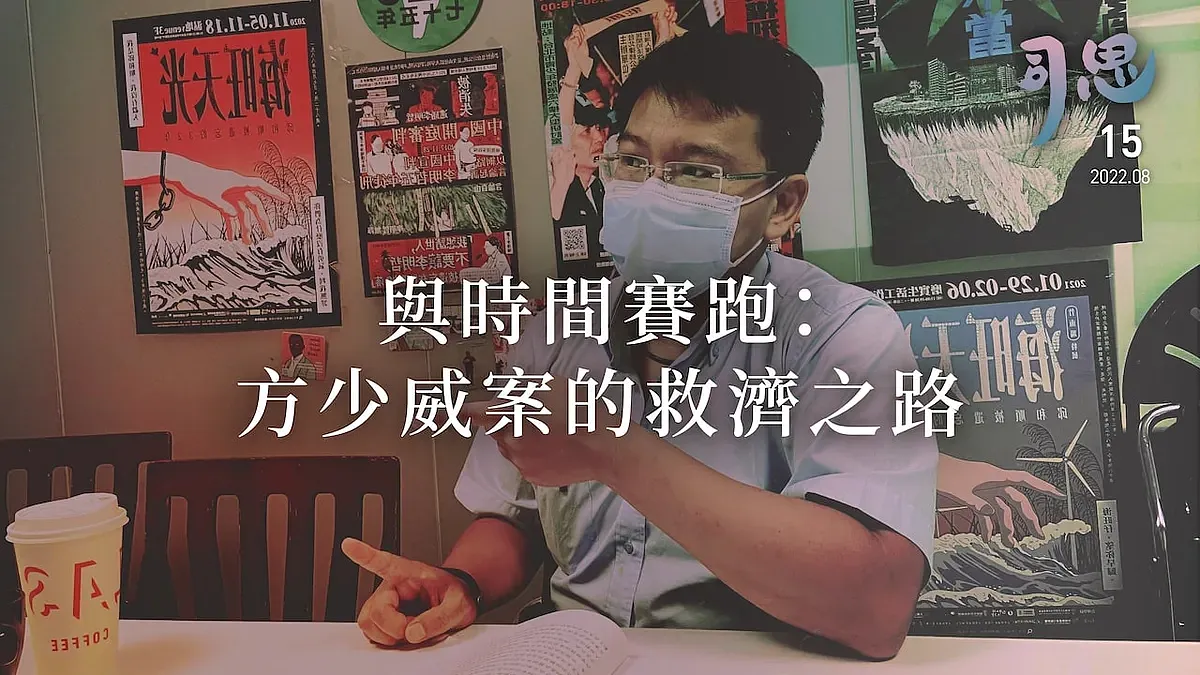
Rootless Residency: Racing Against Time on the Path to Legal Relief in the Fang Shao-wei Case
Last edited: 2026-07-27
Attorney Chou Yu-hsiu currently serves as the convener of the Judicial Reform Foundation's (JRF) Constitutional Litigation Group and as the president of the Taiwan Association for Human Rights (TAHR). He played an indispensable role in the public-interest case of Fang Shao-wei, a collaborative effort between the JRF and TAHR.
When Elder Fang Shao-wei encountered difficulties back then, he did not actually come directly to the JRF. In 2016, Elder Fang first sought assistance from the Legal Aid Foundation (LAF). Following case assignment by the LAF, he faced setbacks including the rejection of his administrative appeal, defeat in administrative litigation, and the dismissal of his Grand Justices' interpretation petition. Ordinarily, his ties with civil society organizations would have ended here; however, Attorney Cheng Kai-hung, who was then handling Fang Shao-wei's case, believed there was an opportunity to file another constitutional interpretation petition. Thus, in 2018, he proposed filing another petition for a Grand Justices' interpretation. Coincidentally, Attorney Cheng Kai-hung and Attorney Chou Yu-hsiu were both volunteer attorneys for the JRF, so Cheng referred the case to the JRF in the hope that they could assist Fang Shao-wei with the constitutional interpretation. That is how Attorney Yu-hsiu came to take on Fang Shao-wei's case through this referral.
The Pressure of Racing Against Time
Fang Shao-wei's case was highly unusual. When Attorney Yu-hsiu took on the case, Fang's mother was already a centenarian, and Fang himself was advanced in years. Although Fang Shao-wei had actually been living in Taiwan for some time, he was repeatedly unable to obtain residency status due to the provisions of the Act Governing Relations Between People of the Taiwan Area and the Mainland Area (hereinafter the Cross-Strait Act). He could only stay in Taiwan short-term on tourist visas. Furthermore, due to his advanced age, Fang Shao-wei was unable to find employment and had no income. He could not even set up a phone line in his own name, nor did he have National Health Insurance. He had to survive solely on his mother's senior citizen allowance and low-to-middle-income subsidies, making life extremely difficult for the two of them. Therefore, Attorney Yu-hsiu candidly admitted that upon taking the case—uncertain of when the litigation could be resolved while needing to account for the client's health—he found himself in a race against time, trying every possible means to resolve Fang Shao-wei's difficulties as quickly as possible.
Because of the case's urgency, when formulating the legal strategy, Attorney Yu-hsiu believed it was necessary to assist Fang Shao-wei through multiple parallel channels. Therefore, aside from the JRF's Constitutional Litigation Division filing a second petition for constitutional interpretation, Attorney Yu-hsiu subsequently united NGO groups like the Taiwan Association for Human Rights. Through petitioning, they hoped to find someone in the legislature or administrative agencies willing to help Elder Fang by establishing a special project or finding another prompt resolution, sparing Fang Shao-wei the hardship of frequent border crossings so he could安心 care for his aging mother.
The Meaning of "Family" and Diverse Imaginations of "Home"
Of course, to fundamentally solve the problem, attention had to be turned back to the path of constitutional interpretation. Attorney Yu-hsiu noted that the primary problem Fang Shao-wei encountered was that when the provisions were originally drafted, the drafters only anticipated scenarios where Mainland China residents came to Taiwan for residency as children accompanying their parents. However, Fang Shao-wei's situation was precisely the reverse: his mother had already come to Taiwan to settle and obtained a Taiwanese ID card during the Chinese Civil War, whereas he only came to Taiwan to care for his mother after cross-Strait family visits were opened. As a result, both followed the footsteps of family members to Taiwan and both constituted a family, yet simply because the roles of caregiver and care recipient were reversed, a caregiver like Elder Fang was legally unable to remain in Taiwan to care for his elderly relative.
This is why Attorney Yu-hsiu raised the concept of the "right to family life" in the constitutional interpretation petition. Following the delivery of Interpretation No. 748, society's imagination of "family" under the Constitution has become increasingly diverse. However, social concepts remain anchored in traditional notions of an "ideal family," causing many "non-typical" families to frequently encounter difficulties in daily life.
In addition, Attorney Yu-hsiu believes that Taiwan currently still lacks the practical realization of the "right to family life." Citing his own experience, the attorney noted that when he went to work in the United States, he was able to apply for visas for his family members to accompany him and live there; yet when foreigners come to work in Taiwan, they are not necessarily able to apply for their families to accompany them and live locally. Attorney Yu-hsiu pointed out that this reveals a Taiwanese mindset that it is acceptable for family members not to live together. However, from the perspective of either the Constitution or international human rights covenants, he views this as problematic—it is tantamount to tearing a family apart through legal provisions. Whether or not to relocate an entire family to live abroad is a family's own choice, but the law should guarantee the right of family members to live together.
Returning to Fang Shao-wei's case, even though Fang currently holds a tourist visa enabling him to enter and exit the country, he cannot reside in Taiwan long-term. This forces him and his family to pay a much higher cost in time and money to be together compared to ordinary people. The law fails to allow the members of a family to live together meaningfully and long-term, which constitutes an infringement upon the "right to family life."
"She Is My Mother; Why Must I Cross Countless Obstacles Just to Care for Her?"
In addition to the "right to family life," Attorney Yu-hsiu also argued in the constitutional interpretation petition that the provisions violated the "right to equality": currently, Article 23, Paragraph 1, Subparagraph 1 of the Regulations Governing Permission for Mainland China Residents to Haves Family-Visitation Residency, Long-Term Residency, or Permanent Residency in the Taiwan Area stipulates: "Where a spouse in the Taiwan Area dies and has not remarried, the parents aged over sixty-five or minor children of the Taiwan Area spouse have no other statutory persons obligated to support them, and there is a need for care by said person in Taiwan."
The peculiar aspect of this provision is that if a lineal descendant by blood of a Mainland China resident wishes to come to Taiwan to care for a lineal ascendant aged over sixty-five who is a Taiwan Area resident, they are unable to apply for family-visitation residency. Yet, lineal relatives by marriage meeting the conditions possess the right to apply for family-visitation residency. Taking Fang Shao-wei's case as an example, he came to Taiwan to care for his biological mother. Both scenarios involve caring for a relative, so why are relatives by marriage permitted while blood relatives are not? Such statutory provisions clearly violate the right to equality and perhaps implicitly harbor the presupposition that Mainland spouses need to come to Taiwan to care for children or parents-in-law.
Although regrettably Fang Shao-wei's second constitutional interpretation petition was once again dismissed in 2020, and post-evaluation indicated very little room left for another constitutional interpretation, the battlefield was shifted to coordination meetings within the Legislative Yuan to seize any opportunity to assist Fang Shao-wei.
Under the failure of the constitutional interpretation petition, according to the current provisions of the Table of Quotas for Family-Visitation Residency, Long-Term Residency, and Permanent Residency for Mainland China Residents, although Fang Shao-wei had already reached the age of 70 and met the permanent residency application qualification for "lineal blood relatives and spouses of Taiwan Area residents who are 70 years of age or older," Fang Shao-wei still needed to wait for the release of slots under the annual quota control. Based on his position in the queue, he would not obtain permanent residency until 2042, by which time he himself would be nearly one hundred years old, raising deeply concerning questions about what his mother's health condition would be by then.
Attorney Yu-hsiu candidly acknowledged that although the ultimate goal is to help Fang Shao-wei obtain a Taiwanese ID card, the current reality is that he cannot even obtain residency. Furthermore, given Fang's status as a Mainland China resident, controls under the Cross-Strait Act are indeed strictly enforced, and there are inherent policy reservations regarding amendments. Therefore, the current hope remains to quickly enable Fang Shao-wei to obtain residency via a special project, allowing him to stay in Taiwan long-term to care for his elderly mother.
Attorneys and NGOs Cooperating to Catch a Client at the Edge of a Cliff
Attorney Yu-hsiu participated in Fang Shao-wei's case for over four years. Speaking of the process of interacting with Elder Fang, Attorney Yu-hsiu honestly stated that interactions with Elder Fang were actually quite limited. He subconsciously maintained an appropriate distance from the client, and constitutional litigation work rarely brings lawyers into contact with clients.
When asked about his impression of Elder Fang, the attorney admitted that because a long time had passed, aside from signing the power of attorney, he had virtually never met Fang Shao-wei in person and actually had no profound impression of him. Through several phone calls with Fang Shao-wei, Attorney Yu-hsiu also felt that Fang was not inclined to discuss legal arguments with him; when receiving phone calls from him, they mostly consisted of Fang recounting his personal experiences rather than discussing the substance of the case. Although Elder Fang sometimes strayed from the core questions when answering, the attorney noted that he mostly encounters this situation when handling cases for elderly clients. Elderly individuals want to explain the events they experienced to their attorney from the very beginning out of a fear that the lawyer might not understand the situation; this is actually a very common occurrence.
"Elder Fang is really no different from ordinary elderly people; there is nothing particularly exceptional about him."
Because he spent long periods staying at home caring for his mother, Elder Fang also needed someone to interact with; otherwise, he might begin to become alienated from society. Attorney Yu-hsiu believes that the work provided by the JRF and TAHR is precisely this kind of work that catches people—exemplifying the cooperative model between lawyers and civil society organizations, where civil society groups attend to the client's needs and act as a communication bridge with volunteer attorneys, allowing lawyers to focus on legal arguments.
Attorney Yu-hsiu mentioned in closing that, realistically speaking, should the day come when Fang Shao-wei's mother unfortunately passes away, even though he would still be able to enter Taiwan on a tourist visa, he would still remain unable to permanently settle on the land where he has actually lived for many years. Therefore, currently, in addition to the legal team initiating a third constitutional interpretation petition, the JRF continues to cooperate with other NGO groups to petition members of the legislative body and various administrative agencies, while assisting Fang Shao-wei in initiating coordination meetings with government units. It is hoped that the government will allow Elder Fang to rapidly obtain Taiwanese identity through a special project, granting him the right to reside in Taiwan legally and securely just like his mother. In this way, not only would he be spared from enduring decades of bitter waiting, but Fang Shao-wei could also care for his mother without lingering anxieties.
Related Materials
This article is an AI-generated translation of the original Chinese text. In the event of any discrepancy, the Chinese version shall prevail.
