
JRF Statement | The Current State of the Judicial System: Blatant Violation of Non-Disclosure in Criminal Investigations
Last edited: 2026-07-27
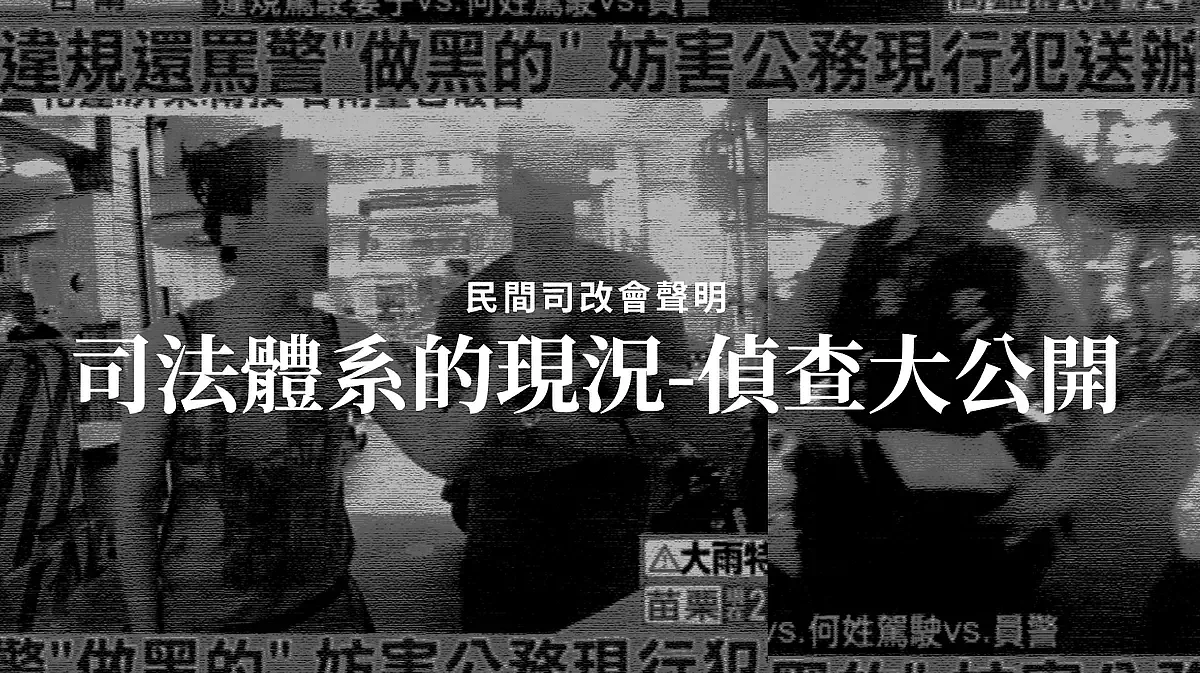
A party who questioned the legality of police enforcement was unlawfully arrested and transferred by police officers. Furthermore, the police released edited body-worn camera footage, creating an image of the party as an unreasonable troublemaker who broke the law first and talked back to the police. As a result, the party had to face not only the criminal justice system for the offense of obstructing a public officer, but also online cyberbullying in the "Accusing Police of Underhanded Dealings" incident. With the assistance of the JRF duty lawyer team for the principle of non-disclosure in criminal investigations, a state compensation lawsuit was filed, leading to the 2021-Shang-Kuo-Zhi-No. 4 Judgment rendered by the Taiwan High Court Tainan Branch. This judgment not only once again highlights that our country's standard for determining the principle of non-disclosure in criminal investigations is overly lenient, but also serves as a microcosm of the current state of "blatant violation of non-disclosure in criminal investigations" in our country. While expressing its regret over this judgment, the Foundation also addresses the situation highlighted by this case: the long-term neglect of the principle of non-disclosure in criminal investigations by our judicial system, unlawful police enforcement, and the lack of remedies available to the people.
Current State of Blatant Violation of Non-Disclosure in Criminal Investigations
The "principle of non-disclosure in criminal investigations" means that before the investigative procedures of prosecutors and the police for a criminal case are concluded, in order to ensure the right of criminal suspects and defendants to be presumed innocent and to ensure the smooth progress of criminal investigation procedures, the contents obtained from the investigation shall not be made public. This is a very important principle for human rights protection in criminal justice.
However, to this day, we can still see many photos and videos of prosecutors and police handling cases from news media such as television and the internet. Even on some official social media platforms run by the police themselves, videos of high-speed chases and subduing criminals, proactively published to promote a positive image of the police, can be seen. Below these thrilling videos, many comments from internet netizens expressing a sense of "sweet revenge" can be found. Yet, what is sacrificed behind the scenes are the rights of the parties involved. In addition to potentially being wrongly stigmatized as "criminals," the chorus of criticism from netizens may also cause damage to the reputation and personality rights of the parties, and the mental anguish caused to the parties goes without saying. The judgment of the Taiwan High Court Tainan Branch is tantamount to once again acquiescing to such behavior of "blatant violation of non-disclosure in criminal investigations" by the police.
The Foundation has long been concerned about the implementation of the principle of non-disclosure in criminal investigations in our country. For many years, cases receiving administrative or criminal penalties for violating the principle of non-disclosure in criminal investigations have been few and far between. Instead, such actions can build a heroic image for law enforcement personnel. Recently, during the arrest process in the Lin Hsin-wu (林信吾) case, National Police Agency Director-General Huang Ming-chao (黃明昭) actually took the lead in allowing the media to film the arrest and suppression process, highlighting the police system's disregard for the principle of non-disclosure in criminal investigations. Following this bad example further fuels the current status quo of "blatant violation of non-disclosure in criminal investigations."
The Problem of Unlawful Police Arrests
In this case, apart from the damage caused to the rights of the party due to the violation of the principle of non-disclosure in criminal investigations, the fact that the party was arrested in the name of a flagrant offender of the offense of obstructing a public officer merely for questioning the legality of police enforcement also reveals that our frontline police law enforcement officers seem incapable of making lawful and reasonable judgments regarding the elements of the offense of obstructing a public officer and the preconditions for initiating coercive measures that restrict personal liberty such as arrest. Instead, simply because they were questioned by the public regarding their own negligence during the law enforcement process, they became irritated and abused the offense of obstructing a public officer to retaliate against the public.
Similar cases are common. For example, there was also an incident in Changhua where a precinct chief instructed officers that "a fall occurs as soon as someone pushes" and then arrested protesters using the offense of obstructing a public officer. This highlights that there is still much room for improvement in the current police's judgment of the legality of law enforcement. The Foundation also calls on the National Police Agency to submit a review report regarding the application and implementation of relevant laws and regulations, and to regularly plan relevant educational and training courses in accordance with Article 12 of the "Directions for the Principle of Non-Disclosure in Criminal Investigations".
The Importance of Balancing Human Rights in Police Law Enforcement
Recently, both the incident of violating the principle of non-disclosure in criminal investigations during the arrest of Lin Hsin-wu and the incident where the Sanchong Police Precinct mistook a person and pinned him down demonstrate that the police still need to strengthen their understanding of the principle of non-disclosure in criminal investigations and how to lawfully exercise police powers. The Foundation also hopes that judicial authorities can place greater importance on the principle of non-disclosure in criminal investigations and squarely face the potential infringement of rights inflicted upon the public.
Press Contact
Ch'en Yang, Legal Researcher, Judicial Reform Foundation
Phone: 02-2523-1178#21; 0906-796-327
Email: sandy@jrf.org.tw
This article is an AI-generated translation of the original Chinese text. In the event of any discrepancy, the Chinese version shall prevail.
