
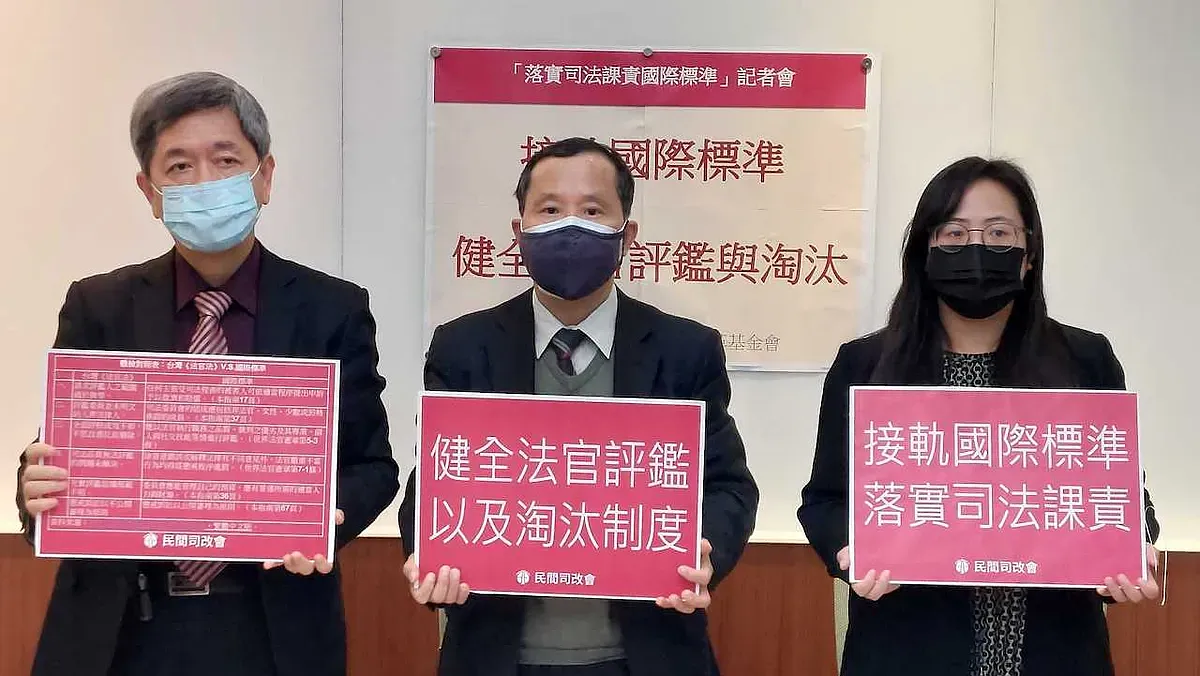
Press Conference | Aligning with International Standards, Reforming Judge Evaluation and Removal ~ Implementing International Standards for Judicial Accountability
Last edited: 2026-11-08
A major event in Taiwan's judicial diplomacy in 2023 is the 65th Annual Meeting of the International Association of Judges (IAJ), to be held in Taipei from September 16 to 21, bringing together representatives from the association's 94 member countries to discuss international judicial norms. This is the second time the IAJ has met in Taiwan; at its previous meeting in Taipei in 1999, it adopted the Universal Charter of the Judge as the universal standard that judges of member countries must observe.
Given that Taiwan's judiciary has long lacked public trust, and that its systems for evaluating and removing judges fall far short of international standards such as the Universal Charter of the Judge, JRF believes this is an opportunity to examine those systems, implement international standards of judicial accountability, and show the world Taiwan's determination and progress in judicial reform.
| Taiwan's Judges Act | International Standards | |
| 1 | The range of people who may request an evaluation is too narrow. | Any victim claiming harm from the judiciary may file a complaint through appropriate procedures and obtain remedy and reparation. (Guide, p. 17) |
| 2 | Evaluation committee members are not expressly required to include non-lawyers. | Judicial councils should include non-judges, women, and members of minority or disadvantaged groups. (Guide, p. 37) |
| 3 | Comprehensive performance evaluation, when it proved ineffective, was abolished rather than improved. | Judges should be evaluated on the quality of their work, the quality of their decisions, and their professional, personal, and social skills. (Universal Charter of the Judge, Art. 5-3) |
| 4 | The problem that judicial quality cannot be evaluated remains unresolved. | Apart from good-faith errors or differences in legal interpretation, serious misconduct by judges may be sanctioned through disciplinary proceedings. (Universal Charter of the Judge, Art. 7-1) |
| 5 | Rules for strengthening the evaluation body are unclear. | The council should manage its own budget and have adequate staff and funding to operate. (Guide, p. 36) |
| 6 | Disciplinary proceedings are closed to the public in principle. | Disciplinary proceedings are open to the public in principle. (Guide, p. 67) |
Source: ICJ, Judicial Accountability – Practitioners Guide No. 13, Traditional Chinese edition.
To introduce Taiwan to the accountability standards observed by the international community, JRF translated the International Commission of Jurists (ICJ) publication "Judicial Accountability – Practitioners Guide No. 13," which presents international standards on accountability mechanisms for judicial corruption and judicial violations of human rights. After the Guide was published in 2016, the Universal Charter of the Judge was substantially revised in 2017, incorporating many of the Guide's recommendations, a sign of its influence. As a member of the IAJ, Taiwan is responsible for observing the Universal Charter of the Judge. Moreover, Taiwan has enacted implementation acts giving domestic legal effect to the main international conventions cited in the Guide, such as the International Covenant on Civil and Political Rights and the United Nations Convention against Corruption. Most of the international standards in the Guide therefore apply to Taiwan and can serve as the basis for examining Taiwan's systems for evaluating and removing judges.
-
Taiwan's Judges Act Falls Short of International Standards
Taking the Judges Act as an example, when it was amended in 2020 JRF identified five major problems: 1. the range of people who may request an evaluation is too narrow; 2. evaluation committee members are not expressly required to include non-lawyers; 3. comprehensive performance evaluation, when it proved ineffective, was abolished rather than improved; 4. the problem that judicial quality cannot be evaluated remains unresolved; 5. rules for strengthening the evaluation body are unclear. These problems have also made individual evaluations ineffective in the two years since the amendment, with not a single evaluation request from the public upheld. (See JRF's observation report.)
On problem 1, Chapter 2 of the Guide states that allowing any victim claiming harm from the judiciary to file a complaint through appropriate procedures and obtain remedy and reparation is the foremost form of judicial accountability. Chapter 4 details the procedural rights of complainants and victims, including having complaints accepted, access to information, being heard, legal aid, and privacy protection. The Judges Act currently allows only parties and crime victims to request evaluations, so others who actually take part in hearings, such as litigation agents, legal representatives, informants, and witnesses, cannot file complaints even when harmed by the judiciary, which clearly falls short of international standards. The Judges Act's protection of complainants' procedural rights is also extremely inadequate by international standards.
On problems 2 and 5, Chapter 3 of the Guide explains that an independent judicial council or similar body is the accountability mechanism recommended by many international standards, that its membership should include non-judges, women, and members of minority or disadvantaged groups, and that the council should manage its own budget and have adequate staff and funding, citing extensive examples of national legislation. The Judges Act's problems of insufficient diversity among evaluation committee members and the committee's chronic shortage of funding and staff can be addressed by drawing on these international standards.
On problem 4, Chapter 2 of the Guide explains that, apart from good-faith errors or differences in legal interpretation, serious misconduct by judges may be sanctioned through disciplinary proceedings, up to removal from office. It cites paragraph 66 of Council of Europe Committee of Ministers Recommendation CM/Rec(2010)12 as a model: "The interpretation of the law, assessment of facts or weighing of evidence carried out by judges to determine cases should not give rise to criminal liability, except in cases of malice." Article 30, Paragraph 3 of the Judges Act currently provides that "views on the application of the law may not serve as grounds for an individual evaluation of a judge," with no proviso excluding cases of malice or gross negligence. This overprotects judges and prosecutors, leaving the evaluation system unable to oversee judicial quality, contrary to international standards.
As for problem 3, comprehensive evaluation falls outside the Guide's scope and is not discussed in the text, but Annex 2 lists in its references the Consultative Council of European Judges' 2014 Opinion No. 17 on the evaluation of judges' work, the quality of justice and respect for judicial independence, which describes comprehensive evaluation systems for judges in European countries in detail.
Because international norms on judicial accountability are now quite mature, the Guide offers answers or references not only for the problems above but for most other areas of the Judges Act in need of reform. Take the Judges Act's principle of closed disciplinary hearings, criticized in the Shih Mu-chin case: public pressure led the Judicial Yuan in August 2021 to approve a draft amendment making open hearings the principle. In fact, Chapter 4 of the Guide already lists the international standards, recommending that preliminary disciplinary investigations be confidential but that hearings be public, proving that reform cannot be done behind closed doors and must connect with the world and learn from advanced rule-of-law systems.
-
Taiwan's State Compensation Act Falls Short of International Standards
Overall, Taiwan's most serious and least recognized gap with international standards is the lack of a system for holding the state accountable. The Guide devotes extensive attention to the subjects of judicial accountability, which include not only individual judges and prosecutors but also judicial institutions and the state as a whole. The reason is that judges and prosecutors are protected by judicial independence; even when they inadvertently violate people's rights in exercising their powers, they may not personally bear disciplinary, civil, or criminal liability. The state should then bear overall responsibility for judicial violations of human rights, ensuring that victims obtain remedy and reparation.
However, Taiwan's State Compensation Act adopts a theory of "vicarious state liability," making the individual public official the subject of liability, and Article 13 strictly limits the scope of liability for judges and prosecutors, making it hard for victims to claim State compensation from judicial institutions. The draft amendment approved by the Executive Yuan in September 2021, while bringing within State compensation cases where judges and prosecutors are disciplined by removal from duty or dismissal, still fails to break out of the old framework and remains far from international standards.
JRF's draft civil society version of the State Compensation Act amendment therefore adopts the theory of the "state's own liability," already widely reflected in practice, changing the subject of liability from "public officials" to "the state or local self-governing bodies" and deleting the special provisions in Article 13 of the current law and Article 5 of the official draft, so that the requirements for State compensation in cases involving judges and prosecutors are the same as for other public officials, in line with the international standards set out in the Guide.
Strengthening judicial accountability is a current trend in the international community's promotion of the rule of law, and reading the Guide helps one grasp the background and direction of these developments. For example, the 2017 revision of the Universal Charter of the Judge cites in its preamble the Council of Europe's Recommendation CM/Rec(2010)12, introduced in the Guide, explaining that the revision aims to support states in making judges "more accountable," and adopts many of the Recommendation's positions, including the "malice or gross negligence" standard of paragraph 66 mentioned above, which became part of Article 7-1, Paragraph 3 of the new Charter. That the Charter was revised after the Guide's publication shows that the international standards it presents have become an international consensus.
-
Comprehensive Evaluation of Judges and Civil Society Participation
In its introduction, the Guide states that its scope is limited to accountability mechanisms for human rights violations or corruption by the state judiciary and individual judges, with particular emphasis on protecting victims' rights. It stresses, however, that while after-the-fact accountability helps deter misconduct, preventive mechanisms are even more important, and recommends following broader international norms. For example, Article 5-3 of the Universal Charter of the Judge provides: "In countries where judges are evaluated, the evaluation should be based on the quality of the judge's work, the quality of decisions, and professional, personal, and social skills." This comprehensive evaluation of judges, though not addressed in the Guide, is highly valued in international norms and is the preventive mechanism JRF has long advocated.
Beyond official mechanisms, the Guide considers civil society organizations to be among the actors in judicial accountability; their monitoring and reporting are vital to judicial accountability and are protected under international law. Before the 2020 amendment of the Judges Act, JRF was one of the civil society organizations entitled to request evaluations, filing more than 70% of all evaluation cases against judges and prosecutors, nearly half of which were upheld. The 2020 amendment removed civil society organizations' standing to request evaluations, and in the two years since, not a single evaluation request from the public has been upheld, showing how important civil society participation is to judicial accountability.
-
Implementing International Standards of Judicial Accountability
In sum, Taiwan's judiciary lags considerably behind the standards required by international norms such as the Universal Charter of the Judge and must urgently catch up. Especially as Taiwan will host representatives of judges' associations from around the world this year, even if the problems cannot be solved immediately, it should at least present a plan to solve them, show the world its determination to reform the judiciary, and seek international support and assistance. With time remaining before the September meeting, we call on the judicial authorities to immediately draw on international standards, comprehensively examine the systems for evaluating and removing judges, and swiftly draft amendments to implement judicial accountability.
-
Download the E-book or Request a Free Copy
JRF's translation of the ICJ's "Judicial Accountability – Practitioners Guide No. 13 (Traditional Chinese edition)" is a free public-interest publication not for sale. The PDF e-book is available for download, and besides copies presented to judicial personnel and institutions, scholars and experts, schools, and libraries for research and collection, anyone may request a free copy from JRF to help spread it:
-
PDF e-book: Judicial Accountability – Practitioners Guide No. 13 (Traditional Chinese edition)
-
To request a copy, contact: Legal Ethics Center; 02-25231178 ext. 25; contact@jrf.org.tw
-
Applicants must pay NT$80 for postage (overseas postage extra); one copy per person, while supplies last.
-
Attendees
Attorney Huang Hsu-tien / Chairperson, Judicial Reform Foundation
Attorney Lin Yung-sung / Executive Director of the Board, Judicial Reform Foundation
Attorney Lee Ming-ju / Deputy Executive Director, Judicial Reform Foundation
Press Contact
Hsiao Yi-min, Office Director, Judicial Reform Foundation, 02-25231178 ext. 25
This article is an AI-generated translation of the original Chinese text. In the event of any discrepancy, the Chinese version shall prevail.
