
Speaking Up for Human Rights: Helping Endangered Lawyers in Afghanistan Find Rebirth
Last edited: 2026-11-08
A Day to Call on Attention for the Lawyers at Risk in Afghanistan
By Ch'en Kuang-wei
Prologue
"Human rights" are supposedly a value to be embraced universally. However, in where the political regime remains unstable, human rights are not readily accessible. After Afghanistan was taken over by the Taliban, not only did the ordinary people become refugees, but even lawyers were persecuted. Ch'en Kuang-wei, one of the Reporters Without Borders, had once witnessed how the judicial system collapsed in the country. He recently has written to support the lawyers whose human rights are at risk.
In 2022, I traveled to Afghanistan to report on the country. On the flight to Kabul, when the passenger sitting next to me knew that I was going to report on Afghanistan, he immediately said that I might be killed in Kandahar because the Taliban controlled the area, and that even the Afghans were afraid of them.
I don’t mean to increase readers' negative impressions toward the Taliban, but I hope that through my coverage, more people will have a better understanding of Afghanistan. [1]
The Judicial System of the Taliban Regime
Once on the street of Kandahar, I saw a group of people crowding around in the middle of the road, holding a big pile of papers. In curiosity, I asked the local guide what they were doing and was told that they were waiting to “register for case reporting”. In case of a conflict, one would need to register by writing down information of the incident and the accused. The registration assistants would help deliver the documents to the police station, and the police would summon the parties at stake to confront each other in person.
One of our itineraries was to witness the “judicial investigation” in a police station. We were taken to a gloomy but spacious room. There were 3 groups of people sitting on the ground, each with a “police officer” who was there to listen to the different parties in the group. When all the people finished speaking, the police officer would make a final judgement.
The judiciary system collapsed, and all seemed to have regressed to the early stage of the tribal culture, where the elders made decisions for all matters, and resolved all conflicts. In Afghanistan, these people with high status and who can make judgments basing on law are called "Mullah.” Their power comes from inheritance, the wisdom of their ancestors, and the tacit consensus of the tribe. Hence, few people would act against them.
After the Taliban regained power, the system of Mullah replaced that of the judiciary which had been established in Afghanistan for nearly two decades. Lawyers and judges could no longer perform their roles. If they had handled cases involving Taliban members in the past, they might even become targets of threats and revenge.
According to information provided by the Judicial Reform Foundation (JRF) and other international human rights organizations, the Afghanistan Independent Bar Association (AIBA), established in 2008, was responsible for supervising the issuance of lawyers' licenses and for promoting the development of the local legal system in Afghanistan.
But after the Taliban regained power in August 2021, situation changed overnight. The nearly 20-year-old judicial system was on the verge of collapse, and the country went all the way back to the times of rule by Sharia. Instead of being the gatekeepers and defenders for justice and its respective order, many lawyers and judges have become victims and are forced to flee overseas. Among the 6,000 plus members of AIBA, about 1,500 of them are women.
With the help of the JRF, I had a chance to talk to Rafi, an Afghan lawyer who is granted asylum in Europe as a refugee.
Afghan lawyer: I used to handle the Taliban cases, but now I am the one to be handled
Rafi is a member of the AIBA. From 2014 to 2017, he participated in the project on "Cross-cultural Dialogues Between NATO and Afghan University Students" and has long assisted in establishing the domestic judicial system in Afghanistan.
However, Rafi’s life was utterly reversed after Taliban took over Afghanistan. At that time, tens of thousands of people, including former government officials, judicial personnel, and those whose work contradicted the Taliban laws, wanted to leave the country with the western troops. But not everyone had the opportunity to do so. Rafi was lucky to be on the evacuation list because of his long-term contact with NATO.
Rafi left Afghanistan with his wife and children, but his mother, brother, and other family members remained there. As such, Rafi can never have real peace of mind. Taliban started searching the AIBA office after taking over Kabul. All lawyers who had handled "sensitive" cases including those about human rights and women's rights would become Taliban’s targets to purge.
For the lawyers who remained in Afghanistan, their licenses were almost void. "Especially for the female lawyers, they lost not only their jobs but also their lives. Because of me, my family has been forced to move constantly to hide from the Taliban." Rafi told me that many people had to relocate constantly in order to flee from the threats of the Taliban.
The experience of Rafi has reminded me of the feminist activist I interviewed in Afghanistan. She was a radio reporter yearning for freedom, so in a couple of occasions, she took to the streets with her friends to fight for women’s rights. But the Taliban was hard to beat. Many of her friends got arrested and detained, causing heavy psychological pressure. To avoid being tracked by the Taliban, she had to keep changing her domicile and turned on the self-deleted function for the communication software she used.
The pain caused by mental pressure is by no means less than that of physical torture. This is the situation faced by Afghan lawyers. According to statistics, since the Taliban came to power, 7 lawyers have died, with nearly 150 arrested or investigated but had no access to help.
The Day of Endangered Lawyer
After the Ukrainian-Russian War broke out, many of the global resources have been channeled into Ukraine. The crowding-out effect has resulted in many countries in need of international aid being forgotten. In addition, the sanction of the Taliban-controlled Afghanistan by the western countries has resulted in the general rejection of the humanitarian aid and refuge mechanisms from inside the country.
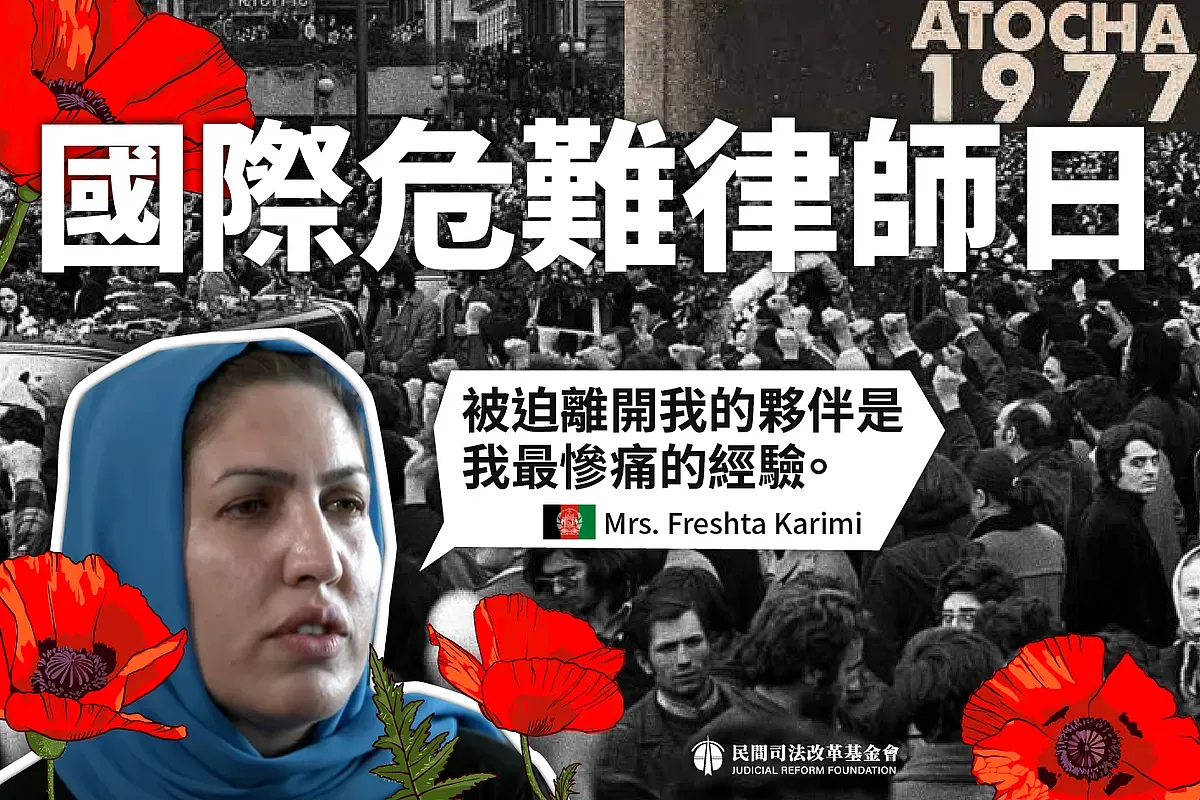
Therefore, the achievement of justice could only rely on the strength of non-governmental organizations. Aurore Lebeau, a Belgian lawyer who coordinated an advocacy campaign for Afghan lawyers on the "Day of the Endangered Lawyer" on January 24, 2023, has expressed deep concern for her fellow counterparts in Afghanistan.
The campaign was carried out in different European countries, including the Netherlands, France, Ireland, and Belgium, etc. In Taiwan, the JRF also cosigned a statement published for the Day and helped enhance the visibility of the Afghan lawyers’ situation by being part of this international campaign action. Indeed, when official channels are blocked, civil societies actions are all the more significant and invaluable, although they are never easy and readily available.
Hans Gaasbeek, who founded the Day of Endangered Lawyer, told me that the Day was first launched to commemorate the four lawyers and a legal worker killed in the Atocha massacre in Madrid, Spain, on January 24, 1977. The Coalition that organises the annual event has had its membership grow from 2 - 3 groups in the beginning up to over 40 groups worldwide currently. Every year, campaigns would be dedicated for the lawyers at risk in a particular country.
Taiwan’s Role
Because of my experience covering Afghanistan, my feelings for the Afghan people under the rule of the Taliban are particularly strong. This is a country trapped in politics, the economics and religious ideologies. Over 80% of its people are living below the poverty line. But to these people, the Taliban regime and the sanctions by the west are like two shackles that would deprive them of any chance for new lives.
The situation in Afghanistan might have been marginalized for long as an international agenda. Fortunately, the Coalition for the Day of Endangered Lawyer saw the problem and has acted to bring the country back to international attention.
Over the recent years, Taiwan has constantly played a vital role in the issue of international aid. Perhaps the particular kind of international suppression Taiwan has undergone has made it more empathetic to those who need assistance. Hence, Taiwan should not restrain from lending its support to the lawyers at risk in Afghanistan because throughout its history, Taiwan has also gone through many human rights crises before being able to enjoy the democracy we have today. ©©
[1] Extended reading: The Story of the Kidney Selling Village in Afghanistan -- are the poor old days done when they all have one of their kidneys gone? (Available in Chinese only)
This article is an AI-generated translation of the original Chinese text. In the event of any discrepancy, the Chinese version shall prevail.
