
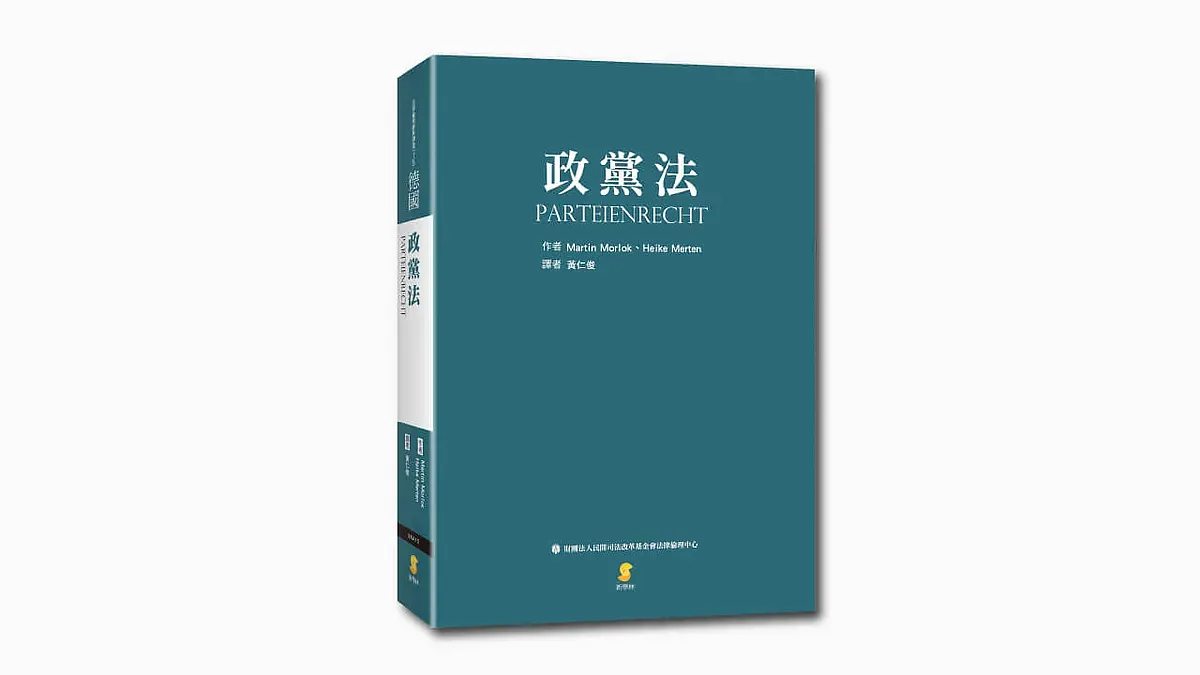
The Political Parties Act
Last edited: 2026-11-08
Party politics is the democratic process that creates law, and also the object regulated by democratic law. Compared with election law and parliamentary law, which have long legal histories, the law of political parties can be called a new continent of legal scholarship. Germany's Political Parties Act of 1967 and Taiwan's Political Parties Act of 2017 are exactly fifty years apart. Through this translation, readers can glimpse the development of Germany's free democratic basic order over those fifty years, see what remains unfinished in Taiwan's free and democratic constitutional order, and reflect together on the future role of Taiwan's Political Parties Act.
Authors: Martin Morlok, Heike Merten
Translator: Huang Jen-chun
Translator's Preface
If democratic politics is party politics, then when parties exercise representation on behalf of the people, they should rely not merely on the moral norms of conscience but on sound legal norms. The premise of a political parties act is to regulate parties by law, so that they follow democratic procedures and help form the public will, and to use judicial enforcement and criminal penalties to guard against one-party dictatorship and curb the tendency toward party oligarchy. Accordingly, this book addresses three central questions: Why does a democracy need a political parties act? How does such an act regulate parties' rights and obligations? Can the law of political parties be judicialized?
Germany's Political Parties Act was enacted in 1967, and the party clause was written into Article 21 of the German Basic Law as early as 1949; its constitutional norms have changed along with the development of party politics. Under the Basic Law, the constitutional status of parties reflects not only reflection on past politics, history, and society, but also the progress of the people, parties, and the state toward democracy, representation, and the rule of law. Article 21 of the current Basic Law expressly provides for the functional definition of parties, freedom to form parties, internal party democracy, transparency of party finances, militant democracy and party dissolution, exclusion of parties from state funding, and the requirement to enact a political parties act. Yet the interpretation and application of these norms still swing between democratic ideals and political reality, between party politics and judicial politics, mixing democratic theory with constitutional doctrine and moving between legal dogmatics and legal policy, all of which readers can appreciate one by one through this book.
Having bid farewell to the tradition of party rule, the party-state system, and the shackles of the ban on new parties, Taiwan's Political Parties Act formally took effect in 2017, the 30th anniversary of the lifting of martial law. Indeed, the foreign legislation Taiwan chiefly consulted, drew from, and learned from in drafting its act was Germany's Political Parties Act. This translation therefore aims, first, to provide a textbook-style translation that helps readers understand the German law of political parties as a whole; and second, in the context of legal reception, to clarify the German-style reasoning that Taiwan's act likewise relies on in interpretation, application, development, and adjudication amid the struggles of party politics. Finally, although Taiwan's and Germany's acts are some 50 years apart, in shaping the democratic values of party regulation the two countries walk a similar road, that of the "free and democratic constitutional order" and the "free democratic basic order," side by side.
For the publication of this translation, I first of course thank Professor Martin Morlok, Professor Emeritus of Public Law at the Faculty of Law of the University of Düsseldorf, for his generous permission. Professor Morlok was Director of the Institute for German and International Party Law and Party Research (Institut für Deutsches und Internationales Parteienrecht und Parteienforschung) at the University of Düsseldorf and President of the Association of German Constitutional Law Teachers (Vereinigung der Deutschen Staatsrechtslehrer). With the concept of "party law scholarship" (Parteienrechtswissenschaft), he opened up the academic horizons of the law of political parties, and the translator has learned much from his teaching and inspiration. I must also sincerely thank the staff of the Judicial Reform Foundation and New Sharing Publishing for planning, editing, typesetting, and proofreading this book. In addition, this translation was supported by the National Science and Technology Council research project "A New Chapter in Militant Democracy (MOST109-2410-H-030-087-MY2)," and was carefully proofread by two NSTC research assistants, Lin Lu-wen, a master's student in the Department of German Language and Culture, and Li Yi-tzu, a master's student in the Department of Law, both at Fu Jen Catholic University, without whom it could not have been completed. My heartfelt thanks to them. Finally, I thank my wife Ssu-min for her understanding and support of my academic work.
Huang Jen-chun
Assistant Professor, Department of Post-Baccalaureate Law, College of Law, Fu Jen Catholic University
Dr. iur., Ludwig Maximilian University of Munich
Summer 2022
Table of Contents
Preface / Chen Chuan-yueh ①
Laying the Ethical Foundations of Democracy and the Rule of Law / Huang Jui-ming ③
Translator's Preface / Huang Jen-chun ⑦
Introduction ⑨
Chapter 1: The Tasks and Functions of Political Parties 001
Chapter 2: The Regulatory Tasks of the Law of Political Parties 065
Chapter 3: The Shaping of the Party System in Law 073
Chapter 4: The Freedom of Political Parties 109
Chapter 5: Equality of Opportunity for Political Parties 139
Chapter 6: Equality of Opportunity for Political Parties 173
Chapter 7: Transparency 203
Chapter 8: Dissolution of Political Parties 223
Chapter 9: Financing of Political Parties and Politics 255
Chapter 10: Political Parties and Elections 307
Chapter 11: Legal Recourse (Rechtsverkehr) and Legal Protection (Rechtsschutz) 317
Chapter 12: Political Parties in the European Union 337
Bibliography 377
This article is an AI-generated translation of the original Chinese text. In the event of any discrepancy, the Chinese version shall prevail.
