
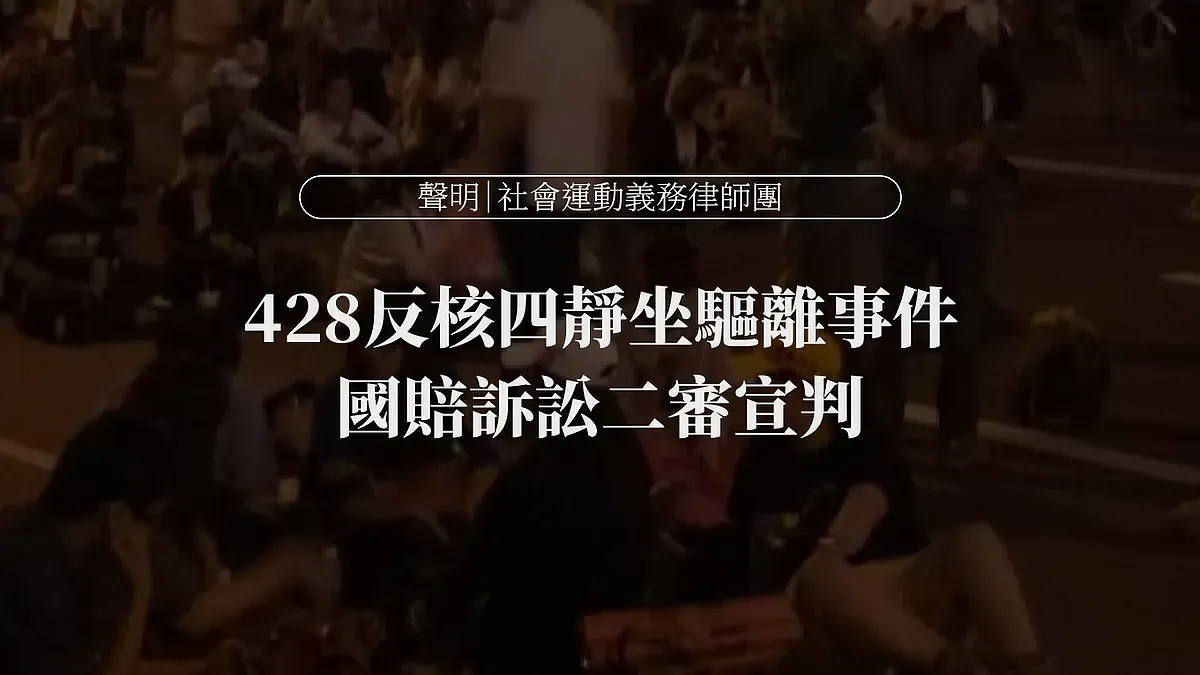
Statement | Second-Instance Verdict in State Compensation Lawsuit over the April 28 Anti-Nuke Sit-in Eviction Incident
Last edited: 2026-07-27
In the early hours of April 28, 2014, citizens holding a sit-in on Zhongxiao West Road to express their anti-nuclear demands were forcibly evicted by police using unlawful violence and high-pressure water cannons. Among them, 15 individuals who suffered physical or property damage filed a state compensation claim against the Taipei City Government and the Taipei City Government Police Department. Today, the Civil Division of the Taiwan High Court delivered its second-instance verdict on this incident, and the legal team issues the following statement:
Taipei City's Unlawful and Violent Eviction of Crowds Participating in the "End Fourth Nuclear Power Plant, Completely Abolish Nuclear Power" Assembly and Demonstration Maintained as a Victory for the People in the Second Instance
Citizens spontaneously organized a lawful assembly and demonstration to "End the Fourth Nuclear Power Plant and Completely Abolish Nuclear Power" based on the right to peaceful assembly and demonstration guaranteed by the Constitution. However, in the early hours of April 28, 2014, while sitting-in on Zhongxiao West Road to express anti-nuclear demands, they were illegally evicted by the police through violent methods such as high-pressure water cannons, causing property damage and physical injuries to many demonstrators.
The injured citizens filed a state compensation lawsuit against the Taipei City Government and the Taipei City Government Police Department. Previously, the Taipei District Court's first-instance judgment ordered the Taipei City Government to compensate 12 plaintiffs over NT$420,000, and the Taipei City Government Police Department to compensate one of the plaintiffs NT$34,000 for property damage. Both parties appealed. In this second-instance judgment, the appeals of the appellants and incidental appellants were dismissed. Regarding the content of this judgment, the legal team will discuss it with the clients upon receiving the judgment before deciding on subsequent actions.
The assembly and demonstration to "End the Fourth Nuclear Power Plant and Completely Abolish Nuclear Power" was a spontaneous, peaceful assembly and demonstration by the people, who appealed to society through rational means to seek consensus, yet it suffered unlawful infringement by state violence. At the time, Taipei City Mayor Hau Lung-bin ordered a time-limited eviction "at all costs," which was the most critical factor causing the crowd's injuries and losses.
Due Process Must Be Strictly Observed; Police Should Strengthen Internal Legal Education and Implement SOPs for Police Exercise of Power
The police's unlawful dispersal order violated procedural justice and infringed upon the people's freedom of peaceful assembly. The means of eviction through related forms of violence violated the constitutional principle of proportionality and were likewise unlawful. The time of this incident occurred just over a month after the "March 24 Executive Yuan Violent Eviction Incident"; however, neither the central Executive Yuan nor the local Taipei City Government fully grasped the constitutional significance of lawful assemblies, frequently expelling peaceful crowds with unlawful violence, which must be condemned.
As the final line of defense for human rights, the legal team sincerely thanks the court for its willingness to shoulder responsibility, fully performing the role of checks and balances in the separation of powers, and sternly correcting continuous administrative overreach. We expect police authorities to respect the judgment, strengthen internal legal education, and implement the Standard Operating Procedures (SOPs) for police exercise of power to prevent the recurrence of violations against people's fundamental rights.
This case has spanned eight years. During the proceedings, the former convenor of the pro bono legal team, Attorney Wang I-chin, passed away due to illness. Losing a champion of human rights who steadfastly pursued justice and cared for the disadvantaged, the entire legal team feels a deep sense of sorrow. We thank Attorney Wang I-chin for her contributions to the legal team, and hope that her spirit in heaven may find some comfort in today's partial victory upholding the first-instance judgment for some of the plaintiffs.
Press Contact
Attorney Li Ming-ju, Deputy Executive Director, Judicial Reform Foundation
This article is an AI-generated translation of the original Chinese text. In the event of any discrepancy, the Chinese version shall prevail.
