
August 13 "National Day is Dead, Hoping for Hsin-fu and Ho-shun's Return" — Wrongfully Convicted Death Row Inmates Take to the Streets
Last edited: 2026-11-08
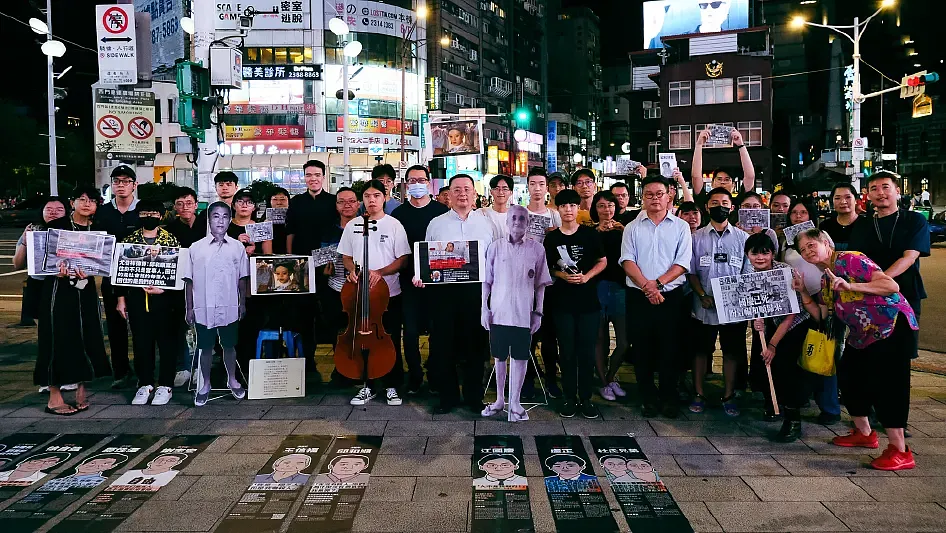
At 7 p.m. yesterday (August 13), the Chiou Ho-shun Rescue Team and the Wang Hsin-fu Rescue Team held the event "National Day Is Dead, Hoping for Hsin-fu and Ho-shun's Return — Wrongfully Convicted Death Row Inmates Take to the Streets" outside Exit 6 of Ximending MRT station. For the first 15 minutes, a team member wearing handcuffs and leg irons played a death row inmate and walked at the head of the procession, leading participants in a silent march around the Ximen shopping district. The procession then returned to Exit 6 for a relay of short speeches and a cello performance. Many members of the public spontaneously joined the march. Back at the starting point, rescue team members handed out flyers about the Wang Hsin-fu and Chiou Ho-shun cases to passersby; many stopped after hearing about the cases, stayed to listen to the speeches, and remained with us until the end, standing with Wang Hsin-fu and Chiou Ho-shun.
The event revolved around two themes: "Never forget Chiang Kuo-ching" and "Keep watching the cases of Wang Hsin-fu and Chiou Ho-shun." Moderator Lo Li-han, Advocacy Officer at the Taiwan Alliance to End the Death Penalty, noted in her opening that today, August 13, marks 27 years since Chiang Kuo-ching was wrongly executed. The Chiang case arose in 1996; on the strength of a confession obtained through torture, Chiang was sentenced to death by final judgment and executed in less than a year. Although after more than a decade the case was finally overturned in 2011, how can a lost life be brought back? And if the Chiang case seems long ago, we should look all the more at the cases of Lu Cheng and the Tu brothers, also wrongly executed by the state and still awaiting vindication, as well as the cases of Wang Hsin-fu and Chiou Ho-shun, still alive in detention awaiting rescue. This is not something from the last century; it is happening now.
Attorney Lin Chun-hung, pro bono lawyer in the Chiou Ho-shun and Wang Hsin-fu cases, then briefly explained the two cases. He said we continue to knock on the doors of the judiciary, the courts and prosecutors offices, in both cases. The Control Yuan has issued many investigation reports on the two cases, all stating that they are wrongful convictions. The Prosecutor-General once filed an extraordinary appeal on Chiou's behalf, but the courts have never responded. Chiang Kuo-ching was executed by the state at 21; we do not want two more innocent lives wrongly taken because of judicial errors, and we hope to see them vindicated while there is still a chance. He also called on the public to keep following both cases.
Attorney Lin Hung-wen, lawyer in the Chiou Ho-shun case, spoke about the torture. In the recording of police interrogating Chiou and his co-defendants that the moderator had just played, Taipei City Criminal Investigation Division officers can be clearly heard saying, "Bring in the pepper water," and "What color? Every time I hit you, you turn a different color? Tell the truth." Two retired police officers from Hsinchu once contacted JRF, saying they had worked on the case and had heard back then that Chiou and others were tortured. Even so, the courts still refuse to confront the confessions obtained through torture. Officers who tortured suspects in this case were even prosecuted and convicted, yet Chiou's case still has not been reopened.
The moderator then introduced the two pieces to be performed by guest cellist Huang Ting-wei: "Forgetting the Spring Breeze" and "Homeland at Twilight." Both were banned songs during martial law. Although the two cases occurred in the early years after martial law was lifted, it is clear that their investigative methods were inherited from the authoritarian era: the two men were treated with intimidation, torture, and improper interrogation, which directly led to their wrongful death sentences. The second song expresses longing for one's hometown. Chiou is from Zhunan, Miaoli, and Wang from Chiayi; both have deep ties to their families and hometowns, and their homesickness often shows in their letters and in face-to-face visits.
After the music, Chiang Meng-chen, Office Director of Covenants Watch, spoke. She hopes Taiwan will incorporate the Convention against Torture into domestic law. Torture and police beatings clearly occurred in the Chiou and Wang cases and in the other wrongful death penalty cases just mentioned; and police violence is not far from us: as recently as this February, teenagers were beaten by police. In addition, the second half of the Convention against Torture, concerning other cruel, inhuman, or degrading treatment or punishment, is also something the international community believes governments should do more to prevent. Ill-treatment can occur in hospitals, at border controls, and in many other places where liberty is restricted, and human rights violations there also need mechanisms to address them. Incorporating the Convention against Torture would help define torture and ill-treatment and establish compensation mechanisms, and more people need to pay attention to and push for this legislation.
Wang Yu-hsiang, researcher at the Taiwan Alliance to End the Death Penalty and volunteer with the Taiwan Association for Innocence, then spoke about the case of Lu Cheng, who has been executed but whose vindication many rescue groups are still actively pursuing. The Lu Cheng case occurred around the same time as the Chiang Kuo-ching case and was likewise quickly concluded with a final death sentence, carried out swiftly despite widespread calls that the case was full of flaws. And just as Chiang's father traveled everywhere seeking his son's vindication, Lu Cheng's two older sisters have refused to give up over the years in their fight to clear their brother's name. The Taiwan Association for Innocence is now mainly assisting with extraordinary remedies in the case, and he hopes everyone will keep following its progress.
Peng Hsiao-ju, a member of the Hsin-fu and Ho-shun volunteer group who has long followed wrongful death penalty cases, drew on her own experience to explain why these two cases matter. No matter how advanced technology or forensic methods become, she said, those making judgments and decisions can still fall prey to cognitive bias and their own subjective views, ultimately causing wrongful convictions. Wrongful convictions will never disappear, so we must always be vigilant and at least work to reduce them. Now that we have the Citizen Judges Act, any of us may become a citizen judge deciding someone's guilt. We must be very careful with every decision; any of us could become a victim, or could become the maker of a wrongful conviction, so she believes we should all pay attention to wrongful convictions.
Mido, JRF Advocacy Officer and organizer of the event, noted finally that whenever a major homicide occurs in Taiwan, Wang Hsin-fu and Chiou Ho-shun are often singled out, because one is the oldest death row inmate, at 72, and the other the longest-held, at 36 years. "They're so old and have been locked up so long; why haven't they been executed yet?" is a deeply ironic sentiment. Each time they are mentioned, she hopes more people will find the courage to tell others that these two cases are wrongful convictions. Chiou's mother died in 2014; until her death she joined civil society groups in actions protesting her son's innocence, and Chiou, in prison, could not even see her one last time. Wang's grandniece, in her twenties, though she does not know him well, has continued to take part in actions with us this year, hoping people will pay attention to her great-uncle's case. Although we are not related to Chiou or Wang by blood, as human beings, Mido said, she hopes everyone can live like ordinary people. When we say Taiwan is a democratic, free country, she hopes we can squarely face this tragedy that occurred under authoritarianism more than thirty years ago and bring it to an end.
Before the event ended, guest cellist Huang Ting-wei performed a final piece, "Mother, Please Take Care." Both men's mothers have passed away. Chiou's mother died of illness during the rescue campaign, and he never got to see her one last time. Wang's father died early, and he grew up relying on his mother alone. Their families are a source of deep longing and attachment for both men, so this song was chosen to close the event, expressing the two men's endless longing for their late mothers.
Chiou Ho-shun Rescue Team
Judicial Reform Foundation, Amnesty International Taiwan, Taiwan Association for Human Rights, Taiwan Alliance to End the Death Penalty, Covenants Watch, Taiwan Association for Innocence
Wang Hsin-fu Rescue Team
Taiwan Alliance to End the Death Penalty, Judicial Reform Foundation, Taiwan Association for Human Rights, Amnesty International Taiwan, Taiwan Criminal Defense Attorneys Association, Humanistic Education Foundation, Taiwan Forever, Criminal Justice Human Rights Committee of the Tainan Bar Association, Covenants Watch, Tainan New Sprout
Press Contacts
Mido (Advocacy Officer, Judicial Reform Foundation), 0938476128
Lo Li-han (Advocacy Officer, Taiwan Alliance to End the Death Penalty), 0970165650
This article is an AI-generated translation of the original Chinese text. In the event of any discrepancy, the Chinese version shall prevail.
