
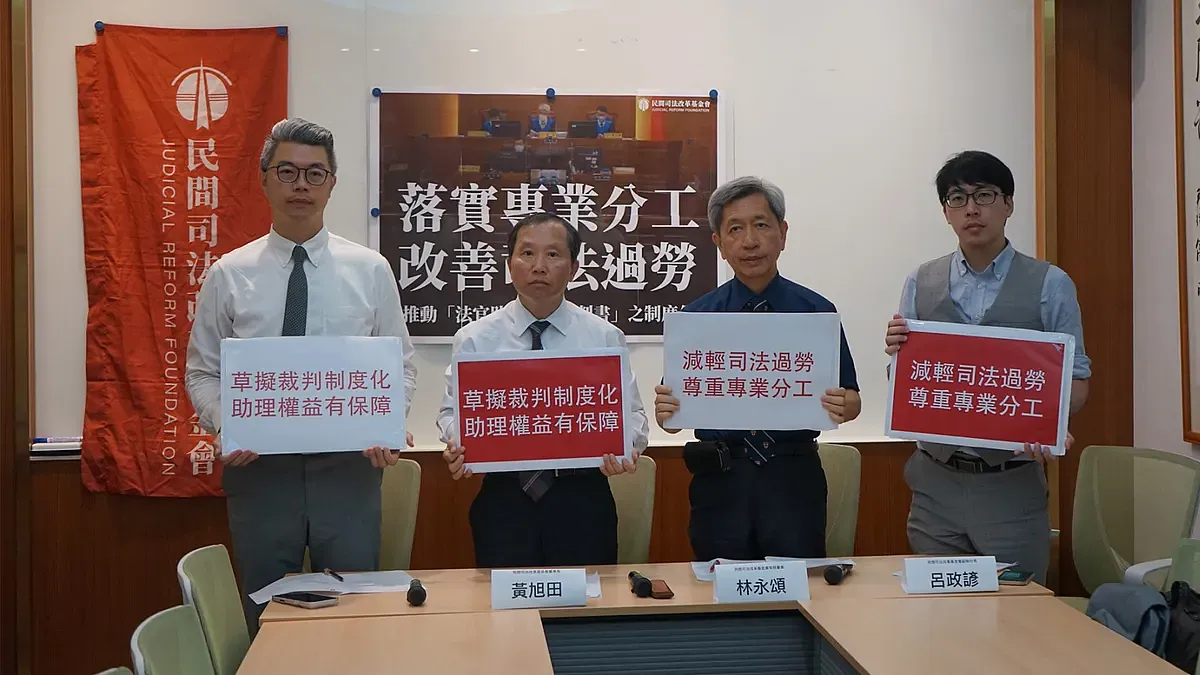
Press Release | Implementing a Professional Division of Labor and Easing Judicial Overwork: Press Conference on Institutionalizing Judgment Drafting by Judicial Assistants
Last edited: 2026-08-26
The JRF previously suggested in the legislative amendment draft aimed at "reducing the judicial burden and enhancing the quality of judgments" that the practice of judicial assistants "drafting judgments" be institutionalized. Recently, this draft has sparked discussions due to a proposal by legislators, which has also raised concerns among judicial assistants.
To broaden the discussion and protect the labor rights of judicial assistants, we must first explain that the purpose of this draft is to promote a professional division of labor within the courts. At the same time, we call upon the Judicial Yuan and all courts to take seriously the labor rights of judicial assistants and respect the professional division of labor among judicial personnel. Only by doing so can we secure cooperation from all sides in the process of promoting reform, thereby achieving an overall improvement in the over-burdened judicial front lines.
In this regard, we hereby put forward four demands as follows:
1. Breaking the unwritten rule: Supporting operational mechanisms should be established for judicial assistants "drafting judgments"
2. No to wholesale delegation of adjudication! The drafting of judgments and rulings by judicial assistants must be institutionalized
3. Respecting professional division of labor is an important step toward alleviating judicial overwork and preventing deterioration
4. The Judicial Yuan must squarely face the labor rights of assistants; reform must not be built upon the sacrifice of grass-roots personnel
1. Breaking the unwritten rule: Supporting operational mechanisms should be established for judicial assistants "drafting judgments"
In Taiwan's judicial system, judicial assistants play an important role in assisting with adjudication. With the surge in litigation caseloads year after year, the judicial assistant system has become an indispensable core pillar for maintaining judicial quality and efficacy. According to Articles 12, 34, and 51 of the Court Organization Act, the work of judicial assistants consists of "handling, under judges' orders, the review of litigation case procedures, analysis of legal issues, collection of information, and other matters." More detailed regulations are enumerated in seven types of duties under Paragraph 1, Article 24 of the Regulations Governing the Selection, Training, Business Management, and Performance Evaluation of Judicial Assistants.
Judging from the aforementioned provisions, it can be found that the current work of judicial assistants does not include "drafting judgments." However, in actual practice, "drafting judgments" has always been a core duty for some judicial assistants. Two research reports in Volume 37 of the 2021 Judicial Research Annual, titled "Policy Evaluation of the Introduction of the Judicial Assistant System to Date," both clearly indicated that this status quo has persisted for years (specifically, the work item "drafting judgment opinions" can be found in the task-point calculation methods for judicial assistants. Taking the Taiwan Taoyuan District Court as an example, in the second half of 2018 and the first half of 2019, 75.7% and 68.5% respectively of the task points (work performance) of judicial assistants in the Criminal Summary Division were derived from "drafting judgment opinions." In other divisions, the proportion reached at least 30%.), and proposed similar legislative recommendations. While the judge's own evaluation of the evidence is unquestionably a core power that cannot be delegated, if a judge personally reaches a conclusion and provides the gist of the reasoning, there is no reason why the judge cannot have the assistant draft the initial reasoning according to the judge's instructions.
For instance, page 1 of the Law Clerk Handbook published by the Federal Judicial Center of the United States mentions: "In general, the broad duties of a law clerk include: conducting legal research, preparing bench memos (case summaries), drafting orders and opinions, editing and proofreading the judge's orders and opinions, and checking citations." Meanwhile, the handbook also clearly states: "The ultimate responsibility for the performance of the judicial function rests with the judge." Therefore, although a judge may ask an assistant to help draft the initial version of the judgment reasoning, the judge must specify the conclusion and the reasons for judgment, and then instruct the assistant to draft the initial version.
That is to say, both in practice and in theory, it is not that judicial assistants cannot "draft judgments," but rather how supporting operational mechanisms should be established.
2. No to wholesale delegation of adjudication! The drafting of judgments and rulings by judicial assistants must be institutionalized
However, constrained by the fact that "drafting judgments" is not a statutory duty of judicial assistants, there are many ambiguities in its operation. Under the current system, there is a lack of clear basis and regulations regarding how judges instruct judicial assistants to draft judgments, and whether written records or drafts are retained.
In practice, some judges, derisively said to "hand over everything," give judicial assistants the entire case file and leave them to evaluate the evidence and draft the judgment on their own, then adopt the draft as the official decision. This method of assigning duties by such judges is tantamount to "outsourcing" adjudication duties and must be strictly prohibited. Conversely, due to the lack of clear guidelines on "drafting judgments," conscientious judges may not know how to assign tasks, or may not dare to (for fear colleagues will see them as lacking diligence).
We believe that the aforementioned problems should be squarely addressed, the practice of assigning "drafting judgments" to judicial assistants should be institutionalized, and both judges and judicial assistants should retain task-assignment records that can be examined and meet actual operational needs, thereby preventing a minority of judges from fully "outsourcing" adjudication. In other words, the intention of the draft is not to legalize wholesale delegation, but to establish clear mechanisms that everyone can follow.
To this end, in addition to explicitly stipulating in the Court Organization Act that the duties of judicial assistants include "drafting judgments," we simultaneously propose the draft of Article 26-1 of the Regulations Governing the Selection, Training, Business Management, and Performance Evaluation of Judicial Assistants as follows:
- Where a judge instructs a judicial assistant to draft judgments or rulings, the judge shall provide the judicial assistant with the gist of the decision and the reasons for the judge's findings.
- The judicial assistant shall record the gist of the decision and the reasons for the judge's findings referred to in the preceding paragraph, and retain the drafting and revision history of each version of the decision in an electronic format subject to third-party inspection.
Of course, these principles could also be written into the Court Organization Act; in practice, implementation still depends on the Judicial Yuan adopting specific, transparent rules that also take efficiency into account.
3. Respecting professional division of labor is an important step toward alleviating judicial overwork and preventing deterioration
Although the aforementioned legislative concept is one of the JRF's proposals for "reducing the judicial burden," its purpose is definitely not to reduce the burden on judges by increasing the burden on assistants. We believe that by establishing a clear division of rights and responsibilities and assignment rules, both judges and judicial assistants can focus on their core duties, thereby achieving efficiency through division of labor.
Conversely, the endless expansion of judicial assistants' duties will undermine this division of labor and instead reduce the efficiency of systemic division of labor. The aforementioned research report, Policy Evaluation of the Introduction of the Judicial Assistant System to Date, criticized the phenomenon of judicial assistants taking turns as court clerks and being seconded to the Civil Enforcement Division, arguing that such work assignments violate the expertise of judicial assistants. However, at the end of last year, the Taiwan High Court comprehensively required judicial assistants to support court clerk work under reasons such as "insufficient courtroom attendants," "it is inappropriate to erode the recording duties of court clerks," and "judicial assistants are most suited" (Press Release Link). In fact, back in 2018, the High Court had already caused dissatisfaction among judicial assistants due to promoting similar practices.
Such practices, which erode the professional division of labor and risk becoming entrenched, ignore the rights and expertise of judicial assistants and dampen their morale, even if they meet short-term needs. However, against the backdrop where the labor rights of judicial assistants have long been unaddressed, the justification for courts unilaterally demanding that judicial assistants—who are hired on a one-year-contract basis and find themselves in a structurally vulnerable position—"weather the storm together in the short term" is already insufficient. In the medium to long term, no concrete plans for improving the manpower problem can be seen, and supporting measures such as a "sunset clause for supporting courtroom attendant duties" and "correspondingly increasing judicial assistant manpower" have also failed to be clearly explained or planned. In conclusion, sacrificing the rights of contract assistants is no different than quenching thirst with poison, which will only drive away and deter outstanding talent, causing further deterioration of the judicial labor environment.
4. The Judicial Yuan must squarely face the labor rights of assistants; reform must not be built upon the sacrifice of grass-roots personnel
In fact, in the aforementioned research report, Policy Evaluation of the Introduction of the Judicial Assistant System to Date, questions were raised regarding the impropriety of hiring judicial assistants on a one-year-contract basis. Voices calling for the improvement of labor rights and conditions for judicial assistants over the years can be enumerated as follows:
- The duties of judicial assistants are obviously regular and continuous in nature, yet they are hired on a one-year-contract basis, placing the labor relationship of judicial assistants in a state of uncertainty. Therefore, when their rights are infringed upon or they encounter workplace bullying, they may also worry about whether it will affect their contract renewal, making it difficult for them to actively strive for or safeguard their own rights.
- Practices regarding overtime pay for judicial assistants vary across district courts and fail to reflect actual overtime conditions:
- There are caps on overtime pay expenses or caps on hours, which severely fail to match actual overtime conditions;
- There is no overtime pay, and not even compensatory leave;
- There are limits on the number of times overtime can be claimed retroactively, and approval from the court president is required.
- There is a lack of systematic pre-service and in-service professional training for judicial assistants.
However, in the aforementioned controversy regarding the High Court demanding that judicial assistants support courtroom attendant duties, the reason given by the High Court in denying the judicial assistants' criticism that it was "pushing policies forcefully" and "forcing judicial assistants to act as firefighters" was surprisingly that "meetings were held with 'judges' and their consent was obtained," and "after approval, judicial assistants were 'notified' and training was conducted." From this practice, one can imagine that the distrust and dissatisfaction of judicial assistants toward the judicial authorities will only continue to increase.
Based on this, regarding the draft proposed by the JRF and the improvement of labor conditions for judicial assistants, we also plan to issue a public questionnaire after the meeting to consult the opinions of the judicial assistant community and judicial personnel, serving as an important reference for the JRF in promoting related bills and conducting reform advocacy.
We call upon the Judicial Yuan and all courts to prioritize communication with judicial assistants, address and improve their labor rights, so as to gain cooperation from all parties when promoting reform.
In addition to "institutionalizing the drafting of judgments by judicial assistants," we also have multiple legislative advocacy items for "reducing the judicial burden." We simultaneously urge the public to pay attention together in order to improve the over-burdened judicial environment and achieve the goal of enhancing the quality of judgments.
Press Conference Time
June 4, 2026 (Thursday) 9:00
Press Conference Location
Room 102, Legislative Yuan Research Building (Chung-Hsing Building), No. 3-1, Sec. 1, Jinan Rd., Zhongzheng Dist., Taipei City
Attendees
Huang Hsu-tien | Chairperson, Judicial Reform Foundation
Lin Yung-sung | Standing Board Director, Judicial Reform Foundation
Tsai Hsueh-i | Standing Executive Committee Member, Judicial Reform Foundation
Lu Cheng-yen | Deputy Executive Director, Judicial Reform Foundation
Press Contact
Lu Cheng-yen, Attorney-at-Law, Deputy Executive Director, Judicial Reform Foundation
Phone: 02-2523-1178#37
Email: elvin@jrf.org.tw
This article is an AI-generated translation of the original Chinese text. In the event of any discrepancy, the Chinese version shall prevail.
