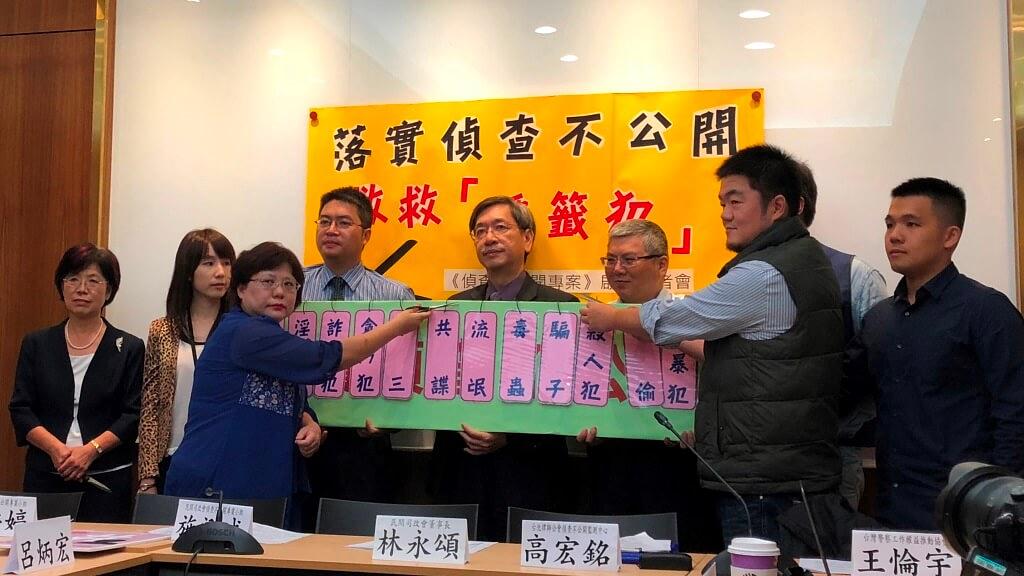
Police Misconduct & Breach of Investigation Confidentiality
Article 245, Paragraph 1 of the Code of Criminal Procedure provides that investigations are not to be made public. The rule binds the police, prosecutors and the Investigation Bureau, who may not disclose what they learn in a criminal investigation before trial.
In practice the rule is broken constantly. Whether to show results or to win media attention, investigators leak details of cases that then fill television news, newspapers and the internet. The people involved lose their privacy and reputation, and the case becomes a label they can never remove.
Official oversight exists on paper. The National Police Agency acts on complaints from the public and on daily monitoring of broadcast and print media by its command center and the Criminal Investigation Bureau. But the system has little effect: solving a major case earns an officer a commendation, while a breach of confidentiality brings only a reprimand, so some officers simply ignore the rule. Prosecutors and Investigation Bureau agents are almost never disciplined, and prosecutors have told us privately that some district prosecutors offices let reporters walk in and out of prosecutors’ rooms as they please.
Investigation confidentiality exists to protect the privacy of the people involved and to give real effect to the presumption of innocence. When it breaks down, innocent people become the subject of news stories and are tried by public opinion, and the courts come under heavy pressure. JRF launched its Investigation Confidentiality Project in response.
Cases
“Love and Iron Blood”: police videos made from bodycam footage
Police “self-media” casts members of the public without their consent. Any of us could be next.
Everyone is a filmmaker now, and influencers and YouTubers market themselves through video. But you may one day find yourself, without knowing it, the main character of a viral police clip.
“Love and Iron Blood” is a series of short videos released by the Kaohsiung City Police Department. Most of it is edited from footage recorded by officers’ body-worn cameras. The videos have repeatedly passed a million views and give frontline officers a brave, fearless image, and police precincts elsewhere have rushed to copy them. We question whether this use of the footage is lawful.
First, the police themselves have said in interviews1 that body-worn cameras are meant for gathering evidence, protecting officers and reviewing whether mistakes were made in an operation. Under the Ministry of the Interior’s directions on the preservation and management of police audio-visual records2, such footage may not be disclosed at will, let alone edited, produced and posted online for the public, sometimes with captions mocking the people shown.
Second, officers are rewarded for publishing these videos and posts, which encourages them to ignore both the directions and investigation confidentiality. As long as the rewards remain and senior officers see videos as a way to improve the force’s image, leaks of investigation footage will continue.
Third, bodycam clips are edited. Viewers see fragments, not the whole event, which invites labeling and judgment before trial. Crimes have many backgrounds and causes, and the law gives special protection to some offenders, such as juveniles and people with disabilities. None of this is visible in a video.
We call on the police to stop these breaches of investigation confidentiality at once and to stop using members of the public as promotional material. Even people who have committed offenses should not be tried by the media. Anyone harmed by a breach of investigation confidentiality by the police, prosecutors or the Investigation Bureau can file a complaint with JRF.
The Mama Mouth case: Lü Ping-hung
In the 2013 Mama Mouth Café case, also known as the Bali double murder case, the defendant falsely named Lü Ping-hung as an accomplice during the investigation. On 6 March 2013 prosecutors carried out a highly publicized search of the Mama Mouth Café, which Lü ran, and the media covered it at length. It was later established that the defendant had acted alone, and the decision not to prosecute Lü became final. By then, however, the repeated court appearances and the strain had damaged his health.
Because police and prosecutors leaked details of the investigation, Lü was publicly cast as a murderer and his café was dubbed a “Dragon Gate Inn”, after the bandits’ inn of martial-arts fiction. Some 20,000 comments flooded the café’s Facebook page and the business ran into trouble. A photograph of him in handcuffs still circulates online. Years later, strangers on the street still point at him and ask: “Isn’t that Lü Ping-hung from Mama Mouth? Wasn’t he locked up for murder? Why is he out?” He still does not dare walk beside his family in public, and they ask him to wear a hat and sunglasses when he goes out so that he will not be recognized.
The bungled spy case: Kuo Mei-lan
On the morning of 10 February 2014, Kuo Mei-lan, a former reporter at the Central News Agency’s Cross-Strait News Center, was about to leave for Fo Guang University in Jiaoxi, Yilan, to collect her master’s degree in communication. Investigation Bureau agents and local police arrived at her home with a search warrant. When she asked to call her adviser to say she could not come, agents repeatedly told her to respect investigation confidentiality and not mention the investigation. After the search, the Bureau took her in for questioning.
Yet while agents insisted she must not leak anything, the search was all over the news from noon that day. Reports said prosecutors had firm evidence and that she faced an offense carrying a minimum sentence of five years, so prison was inevitable. While Kuo was still being questioned in isolation, unable to contact anyone and not yet told what she was accused of, the media were already calling her a “communist spy” who had violated the National Security Act, bribed and recruited investigators and gathered intelligence for Beijing. The next day one newspaper put the story on its front page with a full-face photograph of her. The media could not have known any of this unless prosecutors or investigators had leaked it.
Prosecutors eventually found that the case had no basis, and the decision not to prosecute became final on 9 December 2014. But the coverage followed her. No newspaper would hire her, and she changed her name to Kuo Hsiao-lan to look for work. Frequent court appearances kept her from holding a full-time job, and she depended on her mother for money. A careless investigation and deliberate leaks seriously harmed her reputation, her right to work and her mental health.
Why investigation confidentiality matters
1. It protects people from trial by media
In both the Mama Mouth case and the bungled spy case, the media reported in detail on unverified information leaked by police, prosecutors and investigators. Before either person was convicted, or even brought to trial, they were portrayed as a “murderer” and a “communist spy”, and their reputations were wrecked.
Even after the decision not to prosecute him, Lü Ping-hung was confronted by a passer-by: “Didn’t you kill someone? Why aren’t you in prison?” Kuo Mei-lan, also cleared, could not find work because of how sensitive the coverage had been and had to apply for jobs under another name. Leaks by investigators had lasting effects on both of their lives.
In other high-profile cases too, leaks combined with excessive coverage make it easy for suspects and defendants to be labeled guilty before any conviction. Public pressure can also influence the courts, quietly eroding the presumption of innocence.
2. It keeps leaked misinformation from distorting evidence
This matters all the more as Taiwan moves toward citizen participation in criminal trials. The Innocence Project, a US non-profit that uses DNA evidence to free the wrongly convicted, had helped exonerate 356 people by 2018. Its study of the first 325 DNA exonerations found that eyewitness misidentification played a part in 72 per cent of them.3 Memory is not a video recording that can be replayed unchanged. It is reconstructed each time, and false information received along the way can create false memories.4
In the Bali double murder case, police improperly disclosed that the defendant had bought joss paper.5 Together with extensive coverage of Lü Ping-hung’s appearance and of an unverified account of how the crime was committed, this led the owner of a joss paper shop to identify Lü, wrongly, as the man who had come in with the defendant. Only further investigation, which established that he had never been to the shop, prevented another miscarriage of justice based on misidentification.
3. It protects innocent family members
In 2018, after a young girl in Changhua died from abuse, police and prosecutors allowed the suspect’s identity to become public during the investigation.6 On hearing a false rumor that the suspect had been released on bail, a group of people went to the suspect’s home, smashed it and scattered funeral money, in an attempt at vigilante justice.7
The Regulations Governing the Non-Disclosure of Investigations list details of an offense that concern the privacy and reputation of the defendant, the suspect, or their relatives or spouse among the matters that may not be disclosed. In the Changhua case, improper disclosure of the details led members of the public to harass and attack relatives who had nothing to do with the crime, violating their privacy and even endangering their lives. That is the opposite of what the rules are meant to achieve.
4. It preserves the investigation itself
When police or prosecutors solve a major case, they often hold a press conference, laying out seized guns, ammunition and drugs on tables and even bringing suspects who have not been indicted, let alone tried, before the cameras. The events are so elaborate that they are nicknamed “temple festivals”.
These press conferences show off the police’s hard work, but they can throw away an investigative advantage. If seized drugs are shown to the press, the gang behind them may recognize its own packaging, or recognize the suspect from his build or clothing when he is paraded for photographs. That gives others a chance to coordinate their stories and destroy evidence.
Take the “dumbfounded cat” meme that swept the internet a while ago. It began with a cat picture and the word “dumbfounded” printed on drug packets seized by police. Once the image went viral, other members of the same gang could simply destroy any packets bearing it, and the police lost the chance to round up the whole network.
What JRF is doing
- Taking complaintsJRF continues to accept complaints about breaches of investigation confidentiality by police, prosecutors and the Investigation Bureau. To file one, book an in-person consultation through our complaint service.
- Watching the TV newsThe National Police Agency monitors the news every day, but its investigations and penalties achieve little. Civic groups will form a working group to watch television news daily, record suspected breaches of investigation confidentiality by investigative agencies, and report them to the authorities at regular intervals.
- Following the official review reportsUnder the Regulations Governing the Non-Disclosure of Investigations, in force since June 2019, the review panels set up by investigative agencies must publish a review report and the results of investigations and disciplinary action every quarter. Civic groups will follow these reports closely and hold the authorities to account.
Rules and guidelines
- Regulations Governing the Non-Disclosure of InvestigationsCurrent version, in force since 15 June 2019 (in Chinese)
- Directions for Prosecutorial, Police, Investigation and Anti-Corruption Agencies on Handling the News in Criminal InvestigationsIn Chinese
- Directions for Police Agencies on the Use of Body-Worn Cameras on Duty and the Preservation and Management of Audio-Visual RecordsMinistry of the Interior (in Chinese)
- Directions for Police Agencies on the Use of Dashboard Cameras in Police Vehicles and the Preservation and Management of Audio-Visual RecordsMinistry of the Interior (in Chinese)
Notes
- Police interview on the purpose of body-worn cameras (YouTube, in Chinese)
- See the two Ministry of the Interior directions under Rules and guidelines above.
- ETtoday, 7 June 2018 (in Chinese)
- The News Lens (in Chinese)
- ETtoday (in Chinese)
- Liberty Times (in Chinese)
- Apple Daily, 26 May 2018 (in Chinese)
If you have been harmed by a leak from police, prosecutors or the Investigation Bureau, you can file a complaint with JRF.