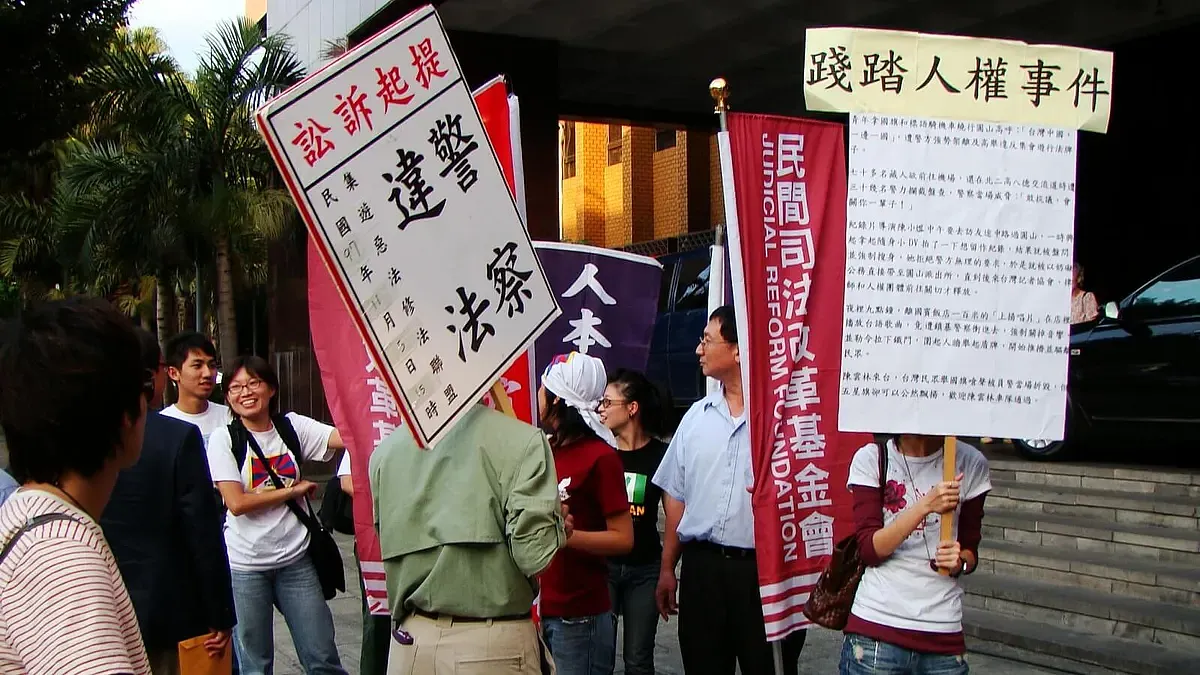
Chen Yunlin Protest Case
Background
From 3 to 7 November 2008, Chen Yunlin, Chairman of China’s Association for Relations Across the Taiwan Straits (ARATS), visited Taiwan for a second round of talks with Chiang Pin-kung, Chairman of the Straits Exchange Foundation. He was the first ARATS chairman to visit Taiwan since the two sides resumed formal negotiations.
Citing the envoy’s safety, the national security and police agencies imposed controls on a scale Taiwan had not seen before. They cleared expressways, banned people from displaying the Republic of China flag or the Tibetan Snow Lion flag in public, walked into shops to turn off music, snatched flags, hauled away people who were filming, and pushed and beat peaceful protesters with shields and batons. Repeated clashes left people injured. On 6 November university students began a sit-in outside the Executive Yuan; after police removed them, they moved to Liberty Square and launched the Wild Strawberries Movement.
JRF answered with legal action. On 5 November, together with the Taiwan Association for Human Rights, Taiwan Labour Front, the Humanistic Education Foundation, Green Party Taiwan, the Taipei Bar Association and others, it filed a criminal complaint against Beitou Precinct Chief Lee Han-ching. On 20 November the groups set up the Legal Team Against Police Brutality, more than 20 lawyers who helped victims bring private prosecutions, complaints and reports to prosecutors.
The events came as Taiwan was preparing to make the two UN human rights covenants part of its domestic law, and they put the government’s human rights commitments to a practical test. They are closely tied to the Wild Strawberries Movement and to the later campaign to reform the Assembly and Parade Act.
Timeline
-
Snow Lion flag seized on Zhongshan North Road
Three people handing out leaflets for free speech along Zhongshan North Road were surrounded by a line of police, held by the arms and had their Snow Lion flag taken from them. They were then held at a police security unit without legal grounds. One of them was injured.
-
Police search Sunrise Records without a warrant
While in charge of security for a dinner between Chen Yunlin and Lien Chan at the Ambassador Hotel, Beitou Precinct Chief Lee Han-ching entered Sunrise Records on Zhongshan North Road without a search warrant, searched its sound system, ordered the music turned off and had officers force the shop to pull down its shutter. JRF considered this unlawful search, coercion and malfeasance under the Criminal Code.
-
Filmmaker forced into a police car outside the Grand Hotel
Ms. Chen, a documentary filmmaker, was filming outside the Grand Hotel after Chen Yunlin had already left. Police stopped her and demanded identification. When she refused, they pinned her against the trunk of a police car, pushed her inside, and four officers carried her into the station by her arms and legs. She was left with bruises and abrasions.
-
Two women pinned to a wall near the Regent Taipei
Ms. Huang and Ms. Tseng were sitting and talking in an arcade across from a side entrance of the Regent Taipei when police pushed and jabbed them with shields and batons and held them against a wall for more than two minutes. Their injuries included a broken finger and a head contusion.
-
Joint statement by civil society groups
The Taiwan Association for Human Rights, JRF and Amnesty International Taiwan issued a statement, endorsed by many other groups, demanding an apology from President Ma Ying-jeou, the resignation of National Police Agency Director-General Wang Cho-chun and National Security Bureau Director-General Tsai Chao-ming, amendment of the Assembly and Parade Act, and a pro bono human rights legal team.
-
First legal action: complaint against Lee Han-ching
At 4 p.m., JRF Executive Director Lin Feng-cheng, joined by the Taiwan Association for Human Rights, Taiwan Labour Front, the Humanistic Education Foundation and Green Party Taiwan, filed a complaint at the Taipei District Prosecutors Office accusing Lee of unlawful search, coercion and malfeasance.
-
Student beaten outside the Regent Taipei
Chiang, a National Taiwan University graduate student watching a spontaneous protest, was pushed and struck with batons and shields by police and alternative service conscripts, then kicked after he fell. He suffered a scalp laceration and other cuts and bruises.
-
Students begin a sit-in at the Executive Yuan
University students gathered outside the main gate of the Executive Yuan to protest police cordons and the unlawful use of force.
-
Police remove the sit-in
Police forcibly removed the students in the evening. They moved to Liberty Square and continued their sit-in.
-
The Wild Strawberries Movement takes shape
At Liberty Square the students set out three demands: an apology from President Ma Ying-jeou and Premier Liu Chao-shiuan, the resignation of Tsai Chao-ming and Wang Cho-chun, and amendment of the Assembly and Parade Act. Students in Hsinchu, Taichung, Tainan and Kaohsiung followed.
-
Nightly silent walk in support
Fifteen groups, including the Alliance to Reform the Bad Assembly and Parade Law, walked silently around Liberty Square every evening from 6 to 7 p.m. under the slogan “Support the Wild Strawberries, protect Taiwan.”
-
Lawyers’ and scholars’ groups issue six demands
The Taiwan Law Society, JRF, the Taiwan Bar Association and the Taipei Bar Association called for, among other things, replacing the permit system with notification, abolishing the criminal penalties specific to the Assembly and Parade Act, and reviewing whether restricted zones are needed at all.
-
Second legal action: the Legal Team Against Police Brutality
The Taipei Bar Association and JRF formed a team of more than 20 volunteer lawyers. At a press conference outside Liberty Square, titled “President Ma, Stop Turning a Blind Eye! The Problem Is Not Just Violence but Violent Police,” the team named Songshan Precinct Chief Huang Jia-lu and several Zhongshan Precinct officers as defendants and announced five cases.
-
Legislature ratifies the two covenants
The Legislative Yuan approved the International Covenant on Civil and Political Rights and the International Covenant on Economic, Social and Cultural Rights, and passed the act implementing them. At the same time, the government’s draft amendments to the Assembly and Parade Act and the handling of the Sunrise Records case showed how far its practice fell short of those commitments.
-
Prosecutors decline to indict Lee Han-ching
After more than five months, the Taipei District Prosecutors Office decided not to prosecute Lee and others. Amnesty International, FIDH and Freedom House had criticized the November policing as falling short of international human rights standards, yet the victims still could not obtain redress through the courts.
-
“I Accuse: The Police State”
The Alliance to Reform the Bad Assembly and Parade Law, formed by JRF, the Taiwan Association for Human Rights and others, gathered with victims outside the Taipei District Court in support of the Sunrise Records case, then marched to the Ministry of Justice to deliver a petition asking it to reconsider draft amendments to the Act that conflicted with the covenants.
What civil society demanded
In November 2008, JRF, the Taiwan Association for Human Rights and Amnesty International Taiwan, later joined by the Taiwan Law Society and the bar associations, called for:
- A public apology from President Ma Ying-jeou for giving up thirty years of progress on human rights and the rule of law to accommodate an authoritarian state.
- The resignation of Wang Cho-chun and Tsai Chao-ming, the heads of the National Police Agency and the National Security Bureau, for policing that repeatedly went beyond the limits of police duties and the principle of proportionality.
- Amendment of the Assembly and Parade Act: a notification system, or notification as the rule and permits as the exception; administrative penalties in place of the Act’s special criminal penalties; and a review of restricted zones.
- Accountability for officers who abused their powers, with the Control Yuan, the Ministry of Justice and other agencies investigating at once and publishing the results.
- Protection for students’ freedom of expression: schools and education authorities must not pressure, threaten, harass or punish students taking part in peaceful sit-ins, and police must not use force simply because no permit was sought.
- A pro bono human rights legal team to take reports of abuses and build a collective legal case against the state. This became the Legal Team Against Police Brutality.
The five cases
The Legal Team Against Police Brutality announced these cases at its press conference on 20 November 2008.
- Case 1Report to prosecutors
Sunrise Records
On the evening of 4 November, Beitou Precinct Chief Lee Han-ching, in charge of security for the Chen Yunlin–Lien Chan dinner at the Ambassador Hotel, entered Sunrise Records at the corner of Zhongshan North Road and Minsheng East Road without a search warrant. He searched the shop’s sound equipment, ordered the music stopped and had officers use force and threats to make the shop pull down its shutter.
- Case 2Private prosecution
Ms. Huang and Ms. Tseng
On the evening of 5 November, the two women were sitting and talking in an arcade across from a side entrance of the Regent Taipei. Police cordoned off the exits around No. 45, Section 2, Zhongshan North Road, then pushed and jabbed them with shields and batons and pinned them against a wall for more than two minutes, breaking a finger and causing a head contusion and abrasions.
- Case 3Private prosecution
Chiang, graduate student at National Taiwan University
On 6 November, while watching a spontaneous protest outside the Regent Taipei, he was pushed and struck with batons and shields by police and alternative service conscripts, and kicked after he fell. He suffered a scalp laceration, abrasions to his left knee, left ankle and right shoulder, and bruising to his right arm.
- Case 4Complaint by the victim
Ms. Chen, documentary filmmaker
At about 11 a.m. on 4 November, after Chen Yunlin had already left the Grand Hotel, police stopped her from filming outside the main building and demanded identification. When she refused, officers surrounded her, pushed her to a police car, pinned her against the trunk and forced her inside. At the Yuanshan police station of the Zhongshan Precinct, four officers carried her in by her arms and legs, leaving her with bruises and abrasions.
- Case 5Private prosecution
Three internet users
On 3 November, while handing out leaflets for free speech along Zhongshan North Road, they were surrounded by police and held by the arms. Police seized their Snow Lion flag, claiming that carrying it broke the rules, injured one of them and held all three at a police security unit without legal grounds.
Besides Lee Han-ching, the defendants included Songshan Precinct Chief Huang Jia-lu and several Zhongshan Precinct officers. The groups did not rule out a third round of lawsuits as more cases came in.
JRF statements and press releases
- 5 Nov 2008Protesting the Ma Administration for Aligning with China’s Low Human Rights StandardsJoint statement initiated by the Taiwan Association for Human Rights, JRF and Amnesty International Taiwan.
- 5 Nov 2008Police Overreach Brings Back the Ghost of the Garrison Command: JRF Files Criminal Complaint Against Beitou Precinct Chief Lee Han-chingThe first legal action, filed at the Taipei District Prosecutors Office.
- 12 Nov 2008Opposing Abuse of Power by Security Agencies and Police, and Reconsidering Whether the Assembly and Parade Act Should Stand: In Support of the Wild Strawberries MovementSix demands from the Taiwan Law Society, JRF, the Taiwan Bar Association and the Taipei Bar Association.
- 12 Nov 2008Civil Groups Unite in a Silent Walk: Support the Wild Strawberries, Protect Taiwan!Fifteen groups walk around Liberty Square every evening in support of the students.
- 13 Nov 2008Cyber Student Movements and Detention to Extort ConfessionsCommentary by Lin Feng-cheng, partly published in the Liberty Times, on the students’ live streams and on detaining suspects to extract confessions.
- 20 Nov 2008President Ma, Stop Turning a Blind Eye! The Problem Is Not Just Violence but Violent Police: Civil Groups Form the Legal Team Against Police BrutalityThe second legal action, with five cases and support from more than 500 scholars.
- 4 May 2009Are We Really Ready for the Two Human Rights Covenants? “I Accuse: The Police State” Press ConferenceAfter prosecutors declined to indict Lee Han-ching, victims and civil groups petition the Ministry of Justice.
Further reading
- Wild Strawberries MovementWikipedia
- Controversy over Chen Yunlin’s visit to TaiwanWikipedia (in Chinese)
- Freedom of Expression / Right of AssemblyJRF: cases, commentary and advocacy on the Assembly and Parade Act
- Anti-Black-Box Services Trade Agreement CaseJRF: the pro bono lawyers’ platform set up in 2014
- Human Rights in ChinaJRF: human rights in cross-strait exchanges