
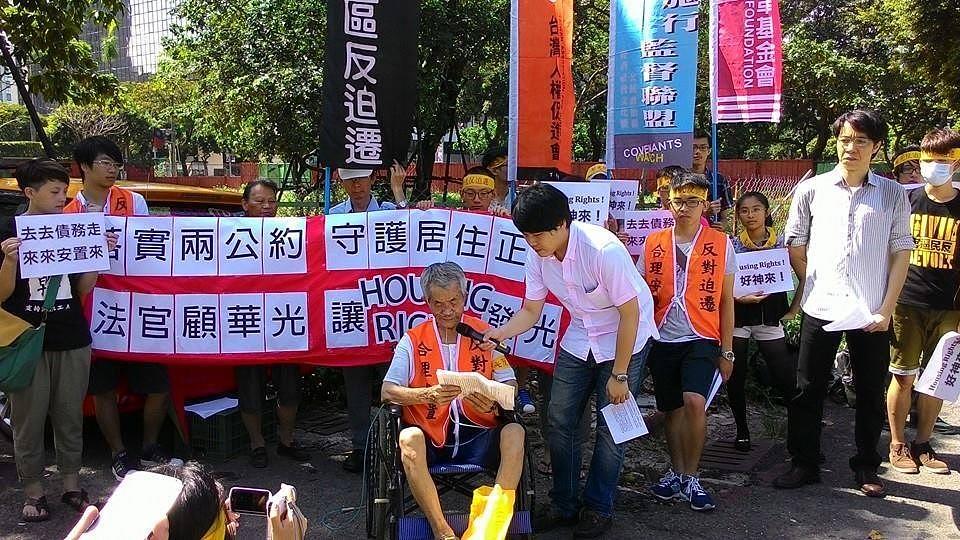
Huaguang Anti-Demolition Case
Background
Huaguang Community sits in central Taipei, bounded by Hangzhou South Road, Jinshan South Road, Jinhua Street and Lane 25 of Hangzhou South Road. Its nearly 10 hectares once held the Taipei Prison and housing for prison and court staff. The people living there fell broadly into three groups: households in government dormitories with recognized tenancy, dormitory households the government treated as unauthorized, and families in homes built without permits. At the end of 2012 a group of students began interviewing residents, and they went on to stand with the families in the unpermitted homes as eviction approached.
The government called these families illegal occupants. The label is misleading. Under the International Covenant on Economic, Social and Cultural Rights (ICESCR), they were residents of an informal settlement, which is not the same as a rooftop extension or any other unlicensed addition. Huaguang grew up on the edge of the city. Before the prison moved out, most residents other than justice-system staff were poor migrants from the countryside.
The students found that families in the unpermitted homes included rural migrants who arrived in the 1950s and 1960s, as well as the children and grandchildren of low-ranking prison and court employees. “If we had money, who would choose to live in a house like this?” residents often asked. They were not squatters who had suddenly seized public land, as the government suggested, but working people who had long supplied the labor a growing city needed.
The land belonged to the Taipei District Court, the Taiwan High Court and the Taipei Detention Center, and the Ministry of Justice began taking it back in stages around 2002. It first sorted dormitory households into authorized and unauthorized. Because the dormitories had been loosely managed for decades, more than half of those households were classed as unauthorized and received no compensation. Families in unpermitted homes had even weaker claims in law, which left them with little protection against the state.
The 2013 protests
Over nearly a year of protest, more than 50 people faced criminal proceedings. One was charged under the Assembly and Parade Act. Every other case was for obstructing public officials in the discharge of their duties.
-
First demolition: excavators move in while people are still inside
The first court-ordered demolition began on 27 March 2013. The two households chosen had already found somewhere else to stay, and officials used this to claim that they owned other property and needed no rehousing. In fact they had left only because the government kept going back on its word, and one family had bought a flat cheaply from relatives for fear of having nowhere to live once the house came down. That the authorities counted even this against them shows how far they were prepared to go to recover the land.
On the day, supporters gathered outside while others, inside the houses and on the roofs, tied themselves to the buildings. Court officials paid little attention to safety and had excavators tear into houses with people still inside. Instead of acting as neutral enforcers, they repeatedly abused supporters and threatened to report them for obstructing officials. They carried out the threat: 5 residents and 26 supporters were referred to prosecutors.
-
Second demolition: streets sealed 13 hours early, 14 supporters arrested
Before the second demolition, members of the student team held up a banner outside the residence of then-premier Jiang Yi-huah. One of them was referred to prosecutors under the Assembly and Parade Act.
On the eve of the demolition, supporters held a quiet concert. Police sealed off the streets without warning, cutting residents off from their supporters, and broke a promise to let shops on Jinhua Street stay open. Later that night a resident refused to take a detour to get home and police ignored him. Residents and students then demanded that the barricades come down, and in the scuffles that followed several supporters were arrested and taken to the Da’an Precinct.
Early the next morning, as demolition equipment moved in, there was another clash and police made more arrests. In all, 14 supporters were referred to prosecutors that day. Prosecutors later added one person as an alleged ringleader, so 15 people in total were referred for obstructing officials.
-
Protest at the Executive Yuan
To break the deadlock and press the central government to take responsibility, Huaguang residents held a press conference at the Executive Yuan. When their attempt to speak with officials afterwards came to nothing, protesters and police pushed and shoved. One supporter was later indicted and, at first instance, sentenced to three months for obstructing officials.
-
“Snails without Shells”: a walk through the ruins
The last action centered on the community was the march of 27 August, “Snails without Shells, a Penitent Walk through the Ruins.” Dozens of people carried rubble and furniture from the demolished homes on foot from Huaguang to Ketagalan Boulevard, while a larger group set out from the community, passed the Executive Yuan and joined them there.
After the march the crowd went on to the Ministry of Justice to demand that it settle the dispute and honor the two UN human rights covenants. Gathered at the ministry’s entrance, they chanted “Huaguang is here on official business.” The ministry called for firm enforcement, and police sent in the Thunder Squad to clear the crowd. Two members of the student team were later referred to prosecutors for obstructing officials.
What the prosecutions show
Compared with other protests of recent years, Huaguang shows a shift in how the state handles dissent. Rather than regulating an assembly as a whole, it now goes after individuals, charging people one by one with obstructing officials. This turns a collective protest into a series of isolated acts and ignores the freedom of assembly protected by the Constitution. The case of the five Huaguang defendants was the first of its kind. Unless something changes, activists now facing prosecution over other causes can expect the same treatment.
Prosecution outcomes
| Event | Non‑prosecution | Deferred prosecution | Indicted | Acquitted / convicted | Total |
|---|---|---|---|---|---|
| 27 Mar 2013, demolition | 31 | 0 | 0 | 0 / 0 | 31 |
| 24 Apr 2013, demolition | 5 | 5 | 5 | 0 / 5 | 15 |
| 23 May 2013, Executive Yuan | 0 | 0 | 1 | 0 / 1 | 1 |
| 27 Aug 2013, march | 2 | 0 | 0 | 0 / 0 | 2 |
| Total | 38 | 5 | 6 | 0 / 6 | 49 |
Outcomes for people referred to prosecutors after each protest. All five deferred prosecutions followed an admission of guilt.
JRF press release
25 April 2013
The Huaguang “Private-Law Dispute” and Police Misuse of the Police Power Exercise Act: Are We Back in a Police State?
Issued jointly by the office of Legislator Tien Chiu-chin, Covenants Watch and JRF. Speakers: Legislator Tien Chiu-chin; attorney Kao Jung-chih, deputy convener of Covenants Watch; and pro bono defense counsel Lu Shih-wei.
Written after the 24 April demolition, when police sealed off the streets 13 hours in advance and arrested 14 supporters, the release made three charges. The Ministry of Justice broke the law it is meant to uphold, recasting a forced eviction as a “private dispute” to be settled under private law. Police followed orders without question and misused Articles 6 and 27 of the Police Power Exercise Act to set up no-go zones. And the eviction breached General Comments No. 4 and No. 7 of the UN Committee on Economic, Social and Cultural Rights, violating both the substance of the right to adequate housing and the procedural protections that go with it.
Further reading
- Without our struggle, there would be nothing here to photograph: the voices left out between Huaguang Community and Rongjin Gorgeous TimeThe Reporter (in Chinese)
- Is rehousing after the Huaguang evictions a favor, not a right?Wang Ting-yu, Plain Law Movement (in Chinese)
- Huaguang CommunityWikipedia (in Chinese): history of the community and the evictions
- Human Rights ConventionsJRF: the two covenants and General Comments No. 4 and No. 7
